
Heads up- How to Avoid Bad Training Advice on Facebook.
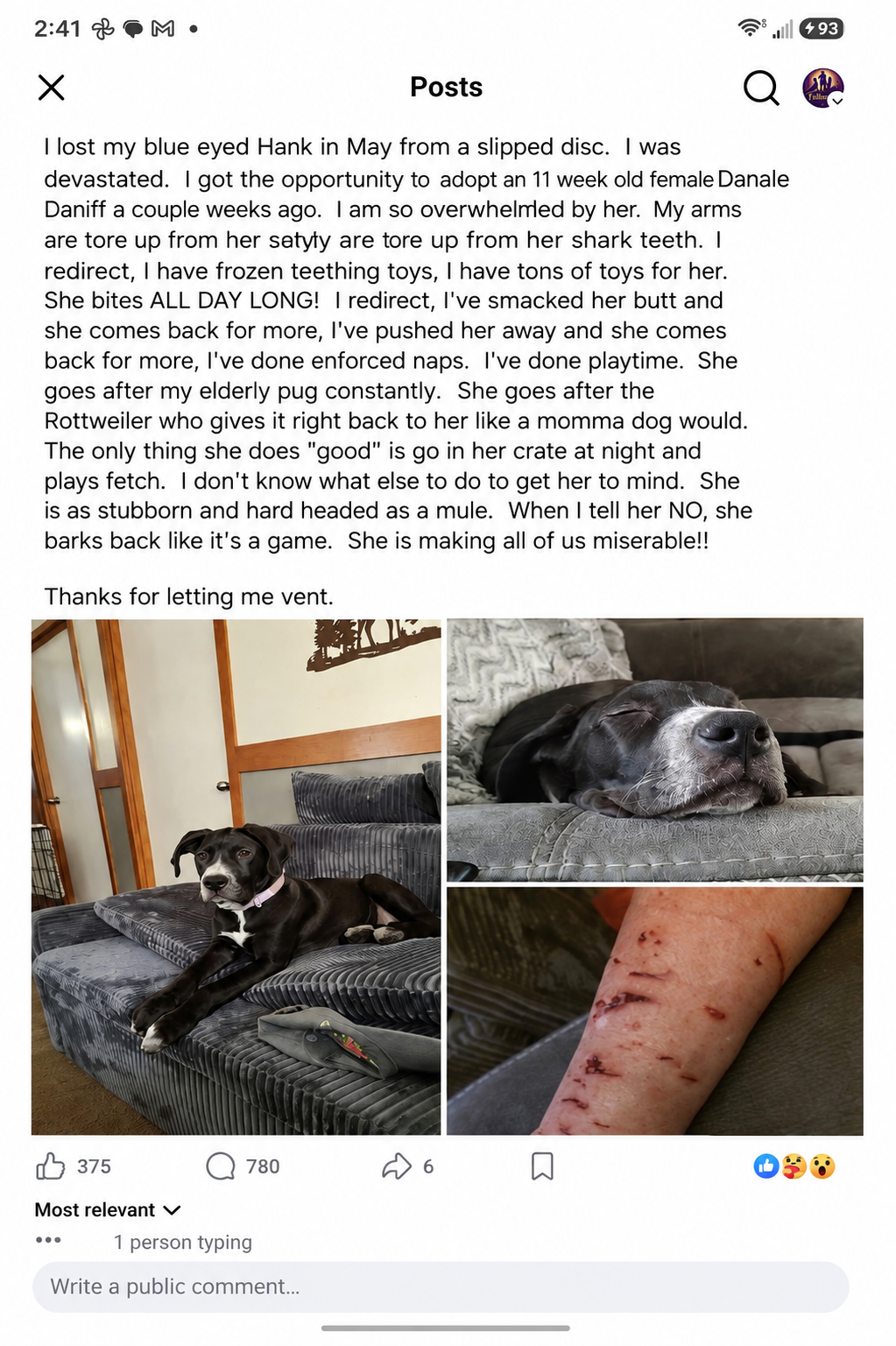
I should know better than to read the comments by now... but here we are.
A woman posted in a local dog group asking for help. Her puppy — an 11-week-old Daniff, so picture a Great Dane and a Mastiff had a baby and that baby is currently made entirely of teeth — was biting her, harassing her older dog, and barking back when corrected. She sounded tired. She sounded overwhelmed. She sounded like every single new puppy owner has sounded since the beginning of time, because what she was describing wasn't a training problem. It was Tuesday. It was a tiny land shark with absolutely no regard for personal space, doing exactly what tiny land sharks do.
The comments did not see it that way.
By the time I stopped scrolling, people had told her to alpha roll the puppy. To pin it. To keep a spray bottle handy. And, the fan favorite, to buy a shock collar — a comment that, at last check, had over 300 likes. Three hundred people looked at an 11-week-old puppy mouthing and pestering and being generally feral, and their collective wisdom was: gadget.
Before anyone starts typing a comment of their own — no, this isn't an anti-remote-collar article. I use remote collars in my own training. I've got an entire separate piece comparing quality e-collar brands, because I think they're a legitimate, useful tool in the right hands. This isn't a "shock collars bad" article, and if that's what you came for, you're going to be disappointed.
What this is, is an article about a much bigger problem than any one tool. Social media has convinced people that dog training problems get solved by buying something. Not by understanding why the dog is doing the behavior in the first place. Just — buy the gadget, and the behavior goes away, and now you're a dog trainer.
Before you correct anything, ask yourself why the inappropriate behavior is happening.
Here's what nobody in that comment section asked: how much sleep is this puppy getting? Puppies need an obscene amount of sleep, and an overtired puppy looks a whole lot like a "bad" puppy — bitier, louder, worse at literally everything, because they're running on the canine equivalent of a toddler who skipped naptime and had a juice box for dinner. Is there structure in this house, or is the puppy just kind of... out, all day, making its own decisions about what's fun? Is the biting and barking being rehearsed — meaning, is it working, is it getting the puppy something it wants, over and over, until it becomes the puppy's go-to move? And maybe the most overlooked question of all: has anyone actually taught this puppy what to do instead? Because "stop that" isn't information. It's a puppy's job to try things and see what happens. If nobody's shown her what does work, she's going to keep offering you what she's got.
None of that requires a purchase. It requires someone looking at the whole dog — sleep, environment, exercise, what's being reinforced — before reaching for a tool. And that's the part social media skips, every single time, because "buy this" fits in a comment and "here's how to actually evaluate a puppy's routine" does not — which is exactly the kind of thing real puppy training actually walks you through.
"I don't even have to use it anymore"
Scattered through that same comment section were a handful of remarks I want to pull out specifically, because I think they're the most honest thing anyone said, even though nobody seemed to notice what they were actually admitting to.
"I don't even have to use it anymore."
"My dog only has to see the remote."
"My dog behaves when the collar goes on."
People post these like trophies. Look how well-trained my dog is — I don't even need the collar anymore, just the sight of it does the job. And I want to ask, genuinely, not as a gotcha: if your dog's behavior changes the second the dog sees the remote, or the second the collar goes on the dog's neck, before any stimulation has happened at all — what exactly did your dog learn?
Because there are two very different things that could be going on there, and they look identical from across the living room. One is a dog who's been properly conditioned to a tool and understands it as part of a clear communication system. The other is a dog who has learned that the appearance of a specific object predicts something unpleasant, and is now managing its own anxiety by complying before that thing happens. Those are not the same outcome, even though both owners get to say "my dog listens." A well-conditioned collar dog shouldn't be a different animal the moment the collar comes out. The equipment is supposed to become neutral — boring, even. If your dog's whole demeanor shifts at the sight of the remote, that's not a finished training job. That's information about how the tool was introduced.
"Just use vibration" isn't the safe answer people think it is
Every time this conversation happens online, someone shows up with the compromise position: you don't have to shock them, just use vibration. It's presented like it obviously solves the ethics of the whole thing, like vibration is the gentle setting and everything else is the scary setting.
Here's the problem. Your dog doesn't know what you call the button. He's not sitting there thinking "ah, vibration, the humane choice" versus "stimulation, how barbaric." He's experiencing a physical sensation, full stop, and he's the one who gets to decide how that sensation lands — not us, and not the marketing copy on the collar's packaging. A lot of budget vibration collars only offer one single intensity, with no way to adjust it up or down, which means you're stuck with whatever that one setting happens to feel like to that particular dog. And for plenty of dogs, especially sound- and touch-sensitive ones, a sudden buzzing against their neck is more startling and more aversive than a low, adjustable level of stimulation that they barely register. "Vibration" sounds kinder in a Facebook comment. It doesn't mean it's kinder to the dog wearing it.
Not all remote collars are created equal, and that matters more than people think
This is the part that almost never comes up in these comment sections, and it's a big one: there is an enormous gap between a quality remote collar — an Educator, a Dogtra, a Garmin — and whatever unbranded import shows up when you search "dog training collar" and sort by price. We're talking the difference between roughly 100 distinct stimulation levels and something like 7 to 10. That gap isn't a technicality. It's the difference between being able to find the lowest possible level a dog can actually feel and communicate with, versus being stuck jumping between settings that might as well be labeled "nothing" and "too much," with no room in between.
I'm not going to sit here and tell you every cheap collar is dangerous — that's its own kind of overstatement, and I try not to deal in those. What I will say is that recommending a stranger on the internet go buy an unknown product, with unknown output consistency and unknown reliability, for a puppy she's never trained with a tool she's never used, based on a comment section — that's the irresponsible part. Not the category of tool. The complete absence of any actual instruction attached to the recommendation.
Hand a toddler a hammer and something bad is probably going to happen. Maybe there's one toddler out there who manages not to smash a thumb or dent a wall, but generally speaking, it's not a great idea. Hand that same hammer to a carpenter, and they'll build you something beautiful. The skill of the hands holding the tool matters — that part everyone already agrees with. But now take a hammer that was thrown together with poor materials and no quality control, something built to look like a hammer without really functioning like one, and hand it to the carpenter instead. It doesn't matter how skilled they are. That tool is going to fail, unpredictably, and probably at the worst possible moment. In both sets of hands, it's a liability. That's the piece people miss when they argue "it's not the tool, it's the handler" like it's the whole answer. The handler matters. The tool's actual quality matters too, and a bad one can undercut even a good handler.
I'll say the quiet part: this is exactly the ammunition force-free trainers use
I'd be doing this topic a disservice if I pretended the other side of this debate doesn't have a point buried in here somewhere. Force-free trainers point to posts exactly like this one when they argue remote collars should be banned outright, and I understand why. When hundreds of people's first instinct, in response to an 11-week-old puppy acting like an 11-week-old puppy, is "shock it," that's not a great look for anyone who uses these tools professionally and responsibly. I'm not going to pretend that reaction doesn't exist, or that it isn't fueling real legislative pushes in some places. It is, and it's a fair thing to be worried about.
But the answer to bad information isn't banning the tool. It's fixing the information.
So what's the actual takeaway
The puppy in that post didn't need a gadget. She needed sleep, structure, something appropriate to chew that wasn't her owner's hands, and someone to show her what to do instead of just being told what not to do. None of that is glamorous. None of it fits in a comment with 300 likes. But it's the part that actually works, and it's the part that gets skipped every single time someone reaches for a purchase instead of an explanation.
A leash isn't dog training. A prong collar isn't dog training. A remote collar isn't dog training. They're tools, and the person holding them is what makes the difference — but as we just established, a good handler with a garbage tool is still working against themselves. Skill and quality aren't competing explanations; you need both. Maybe that's the question worth asking instead of "which collar should I buy": why is my puppy actually doing this in the first place, and am I equipped — in both senses — to address it? Once you know the why, the how gets a lot easier. And the comments section is rarely where you're going to find either.
If you're staring down a puppy who sounds a lot like this one, you don't need a gadget recommendation from a comment section — you need someone to actually look at the whole picture. That's exactly what puppy training with me looks like, in person in Hernando County or through remote coaching nationwide.