
The Most Controversial 2-Letter Word in Dog Training (Part 3 of 4: The Policy War)
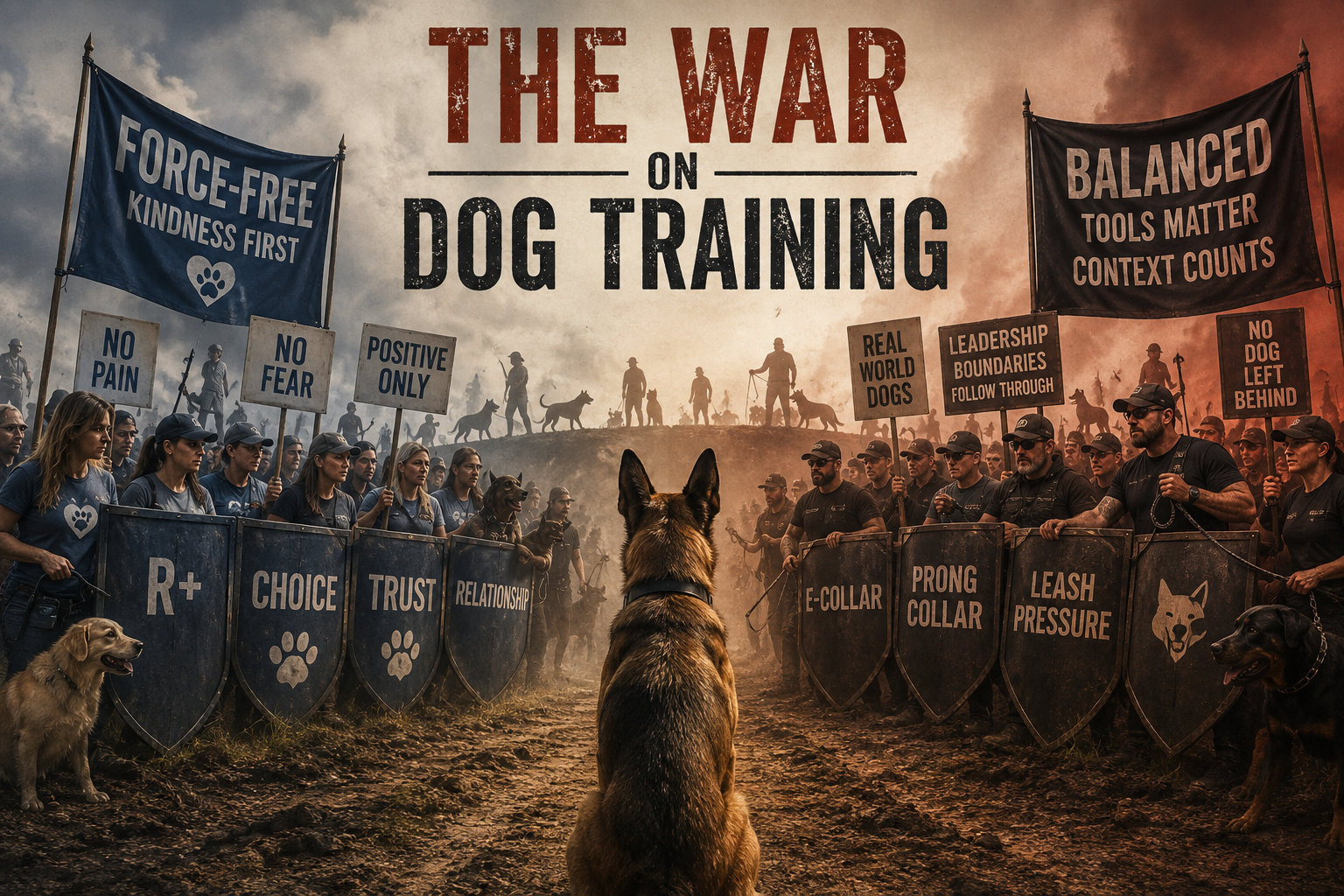
Previously: we covered the four quadrants that explain how every dog (and every human, and every pigeon Skinner ever studied) actually learns, and met the three camps that have built entire careers and philosophies on emphasizing different pieces of that same system — force-free, balanced, and the old-school world that predates the whole framework. If you're just joining us, that's Part 2, the one with the wolf enclosure math and Bart Bellon.
Here's where it stops being an argument about training philosophy and turns into something with real teeth: actual legislation, actual breed bans, actual dogs who are no longer alive because of decisions made by people who'd stopped talking to each other. This is the part of the series I feel the most strongly about, so buckle up.
The welfare argument, and where it falls apart
This isn't just an argument people have online. There's actual policy getting written around it, and that's where the whole "no" debate stops being about a word and starts being about the freedom to choose which camp you're even allowed to belong to. And once that freedom's gone, so is any real discussion on the topic — which puts actual dogs' lives on the line.
Here's the thing nobody seems to want to say out loud: this was never a quiet shift. Trainers have been at open war over this for years — not lobbing pebbles at each other's camp, full-on boulders, the kind you'd need one of those medieval siege throwers to launch. And some of the biggest boulders are coming from celebrity YouTube influencers with zero actual credential in behavior work — Zak George, planted firmly in the force-free camp, being the obvious example, a guy who's genuinely talented at trick training and somehow parlayed that into public authority on behavior cases he has no business weighing in on. His public feud with "Dog Daddy," Augusto DeOliveira of Beckman's Dog Training — coming from the old-school, correction-heavy end of the spectrum — is a pretty good snapshot of the whole ecosystem: DeOliveira publicly offered George $50,000 to actually show up and defend his position in a real exchange, and George never took him up on it. Worth saying plainly, though — DeOliveira isn't exactly a credible alternative either; he's got his own well-documented history of complaints about sick dogs sold and breeding practices gone wrong, and there are documented allegations of dogs dying at rental properties tied to his operation, which he's publicly denied. He went viral in the first place walking a pack of his signature black German Shepherds off-leash through New York City — that breeding line is genuinely what put him on the map. And his content follows the same playbook as the TV era, just compressed into a reel: an out-of-control dog on a leash, some kind of whirling, helicopter-style leash maneuver, and within minutes the dog's supposedly transformed — muzzle off, a pat on the head, best friends, cured, sunshine and rainbows. He's basically a modern Cesar Millan without the motivational-speaker charisma or the actual substance underneath it — same made-for-camera magic trick, minus the one thing that at least gave Millan's version some staying power. Nobody in that particular fight had real standing, and that's really the whole point worth sitting with: two guys with no legitimate claim to authority over the other spent a public feud throwing boulders back and forth, and millions of people watched it like it was a real debate instead of two clowns arguing over who's the bigger clown. Here's the thing though — ask literally anyone with actual credentials, any camp, any philosophy, force-free or old-school or somewhere in between, and they'll agree on that much at least. There were no merits in that fight to begin with. Just volume, production value, and an audience that mistook loud for right. And here's what made it worse: credentialed trainers, actual professionals from every camp, jumped in too — weighing in, condemning, publicly picking apart both of them — and every bit of that attention just fed the algorithm more views, more clicks, more relevance for two people who'd already proven they didn't deserve the platform they had. The system meant to hold people accountable ended up amplifying them instead. That's not a force-free problem or an old-school problem. That's everybody, together, accidentally making a mockery of the whole thing. And the reason any of this matters beyond two men embarrassing themselves online: somewhere in the middle of that noise is your average pet owner, watching the whole spectacle and thinking, genuinely, what the hell is going on here. Where am I even supposed to stand? Who do I actually go to for advice? Who's going to help my dog? That person didn't sign up for a war. They just wanted to know how to stop their dog from pulling on walks, and instead they got handed a battlefield. Somewhere in the middle of all that shouting, "when should we use these tools?" turned into "you shouldn't own them at all," and most pet owners never even clocked the shift happening. The American Veterinary Society of Animal Behavior used to leave room for aversive tools, used carefully, in limited situations — that's basically LIMA, least intrusive, minimally aversive, the framework a lot of the industry organized around. Their current position doesn't leave that room anymore. Reward-based only. No context in which aversives are allowed to outperform them. No carve-out for the tool, the dog, or how skilled the handler actually is. And other organizations have followed right along, turning what used to be judgment calls into rules with no judgment left in them at all.
Meanwhile, out in the actual world — not the position-statement world — a very different story is playing out. Trainers working reactive dogs, working dogs, service dogs, the ones with zero room for error, are watching tool bans reshape policy in places that have nothing to do with a training room. Same logic, recycled: no dog should ever wear an e-collar or a pinch collar, therefore certain breeds shouldn't exist either. If the tool that would've kept a dog's behavior in check gets taken off the table, guess who becomes the liability instead? Not the policy. The dog.
And here's a question nobody in this fight seems to be asking: who's advocating for the human on the other end of the leash? Picture the woman trying to walk her 150-pound, out-of-control Great Dane on nothing but a harness, because she's been told a harness is the kinder option. She's on her way to shoulder surgery at this point — actual, real damage to her own body — and if she finally puts a prong collar on that dog to get some control back, she's the one who gets criticized for it, not the advice that put her in that position in the first place. And the dog's not winning in that scenario either — dragging a person down the street, getting yanked around by someone losing the physical battle, never getting the clear communication that would've actually settled him down. Everybody loses so the harness can stay the "kind" choice on paper.
Take England's XL Bully ban. Owners had to get an exemption certificate, neuter the dog, keep it muzzled and leashed in public for the rest of its life — miss any of that paperwork and the dog gets seized, no appeal that actually works in most people's favor. In under a year, one set of figures alone showed over 500 of those dogs put down. Sit with that for a second. Somewhere out there is a person who loved their dog, did nothing wrong that day, and lost that dog anyway because a law got written by people who'd stopped actually talking to each other about what works. That's what happens when the conversation shuts down instead of staying open: not a tidier debate, a dead dog and a grieving owner who now gets filed under "acceptable losses" in somebody's policy report. Death before punishment. That's the actual trade being made, whether anyone's willing to say it that plainly or not.
I watched this play out in the most darkly funny way possible in 2024, at Crufts. And I want to be clear — Crufts isn't some niche hobbyist thing. It's an international competition, watched by every kind of professional and handler in the dog world, probably somewhere in the hundreds of thousands if not millions of people tuning in. So a police department gets up to do a demonstration: send the K9 after a decoy in a full bite suit. I'm not a protection-work person, I'll say that up front, I don't want to pretend I have authority I don't have — but even I know the single most important part of that whole discipline is the "out." The release. Without a rock-solid out, you don't have a working dog, you have a loose cannon with teeth.
So they send the dog in. The decoy's doing everything you'd expect to spook a normal pet — yelling, banging bamboo sticks — completely irrelevant to a dog bred and trained for exactly this. Clean launch, clean bite, good tug work while the decoy hams up the struggle. And I remember sitting there thinking, they're really doing this whole thing without an e-collar as backup? Then the release cue comes.
The dog does not let go.
Seconds go by. Then more seconds. Then it stops feeling like seconds and starts feeling like an eternity, the kind where you can physically feel everyone in the room realizing this isn't part of the show. They ended up walking the dog offstage still attached to the decoy's arm, which is somehow both horrifying and one of the funniest things I've ever watched happen on live television — like an accidental Benny Hill sketch playing out in front of a worldwide audience. The embarrassment was so thick you could've bottled it.
And look — I know, I know for a fact, that dog releases instantly if it's wearing an e-collar. No hoping the training holds under pressure it's never actually been tested against. No department credibility quietly imploding in front of millions of people. If a dog can't reliably respond to a command, that dog doesn't belong in the field. Full stop. The tool that guarantees the response gets you there. The one that just hopes for it sometimes leaves you standing on a stage with a dog attached to someone's arm.
That's the real welfare argument, and — annoyingly — it cuts both ways. Reward-only advocates are right that aversive tools, used badly, cause real damage. I'm not going to pretend otherwise. But lumping every aversive into one undifferentiated pile — a badly timed shock at painful intensity right next to a well-conditioned, low-level e-collar cue a dog's actually learned to listen for and look forward to — isn't a scientific distinction. It's just a lazy one. And sweeping bans don't make risk vanish into thin air. They just move it somewhere else: onto the dogs labeled untrainable, onto the breeds getting legislated out of existence, onto the handlers who lose tools they were using responsibly, onto the working and service dogs whose training now has to work around methods that used to be a total non-issue.
Welfare has to mean more than "no aversives, ever." It has to mean what's actually happening to the dog across its whole life. Is the dog happy? Well taken care of? Or is the dog showing real signs of psychological or physical harm — the kind a veterinarian or a credentialed, experienced trainer can actually recognize, someone who can see through the noise and tell you what's really going on? That's a completely different question than what most people are actually asking. Anyone can watch a five-second clip and go "oh, the dog licked its lips, it must be being abused," and feel like they've made an informed judgment. That's not an accurate welfare assessment. That's a keyboard warrior taking a guess and dressing it up as expertise.
The confusion this creates for pet owners
Here's a cost to this whole fight that nobody's really accounting for: pet owners are stuck in the crossfire, and a lot of them genuinely have no idea who's actually supposed to answer their questions anymore. Ask your vet? Ask your trainer? Ask whoever posted the most confident thing on Instagram this week?
Veterinary medicine and dog training are two different fields, and the overlap is a lot smaller than the current climate would have you believe. A vet's trained in physiology and medicine — but genuine training in diagnosable behavioral conditions belongs to veterinary behaviorists specifically, a small, specialized group with years of extra residency training most general practice vets simply don't have. That gap is a real problem, because plenty of general vets prescribe behavioral medication anyway, for issues that were never medical to begin with. I've seen this firsthand: a client of mine spent thousands of dollars taking her Jack Russell Terrier to specialists because she was told the dog had some kind of deformity causing it to urinate all over the house. One session with me — actual supervision, a leash indoors, a crate when she couldn't watch him directly — cut the accidents by more than half. Three weeks later, we were at 99 percent, and that remaining one percent was human error, not the dog. No deformity. No medication. Just a training problem that got mislabeled as a medical one, and cost her thousands of dollars to find that out the hard way. Another client of mine had a rescue pit mix on high daily doses of both trazodone and gabapentin, prescribed so the dog wouldn't hurt himself when left alone — and even on that combination, the dog still managed to chew straight through an entire door. After a few months of actual behavioral training, that dog is completely off both medications, settles in his crate through heavy distractions, and shows no sign of separation anxiety anymore. I genuinely don't know what that daily dosing, probably for years, did to that dog's body over time. His vet was likely just trying to help, and I don't doubt that — but help without the training piece just meant the Band-Aid, something that was only ever supposed to be short-term, turned into the long-term plan. Which wasn't really a plan at all. A trainer's job is different. We're the ones actually shaping behavior day to day, on the ground, not diagnosing from behind a desk. There's overlap, sure — a good trainer needs to know when something's actually medical, a good vet needs to know when to just send someone to a trainer instead of reaching for a prescription pad. But somewhere along the way, owners started treating a vet's opinion on training the same way they'd treat a vet's opinion on, say, a torn ligament. And that doesn't hold up, because those two things aren't the same kind of expertise at all. So now people are asking their vet how to fix a training problem and their trainer whether something's medical, and getting a confident answer from both — not because either one's lying, just because nobody's drawing the line clearly anymore.
And the stakes for that owner aren't some abstract policy footnote. One side is telling them that using a tool to get control of a dangerous behavior makes them inhumane. The other side is that same owner, standing in their living room, staring at a dog they can no longer safely manage, weighing rehoming or euthanasia for an animal they genuinely love — because the guidance they got left them without a tool that might have actually worked in time. That's not me reaching for shock value. That's a real thing that happens to real owners who followed reward-only advice on a problem that needed something faster and clearer than it got. And here's the part that gets me: whoever wrote the position statement gets to move on to the next policy debate, completely unbothered. The owner's the one who has to live with what happened. So is the dog.
This is exactly the kind of topic I think every dog owner deserves better education on, not a sales pitch — if you want to keep learning, you can read more about who I am and how I train, or keep going with the series below.
Up next, in Part 4: we come back down from the policy fight to the ground level — what actually happens when a tool gets used well versus badly, why teaching a dog boundaries is a form of protection rather than cruelty, and where I've personally landed after pulling ideas from camps I don't even belong to. Plus the actual, practical version of everything this series has been building toward: what to do with your own dog tonight.