What Is a Guardian Home?
Raising the Next Generation of Follow My Lead Great Danes
One of the hardest parts of breeding for me is also one of the most important: I can't keep every puppy who shows promise.
When you spend months planning a litter, raising the puppies and watching their personalities develop, it's incredibly tempting to keep every puppy who makes you think, I really want to see what this dog becomes.
But keeping every potential breeding prospect isn't necessarily what's best for the dogs—or for a breeding program.
That's where my guardian/co-owner homes come in.
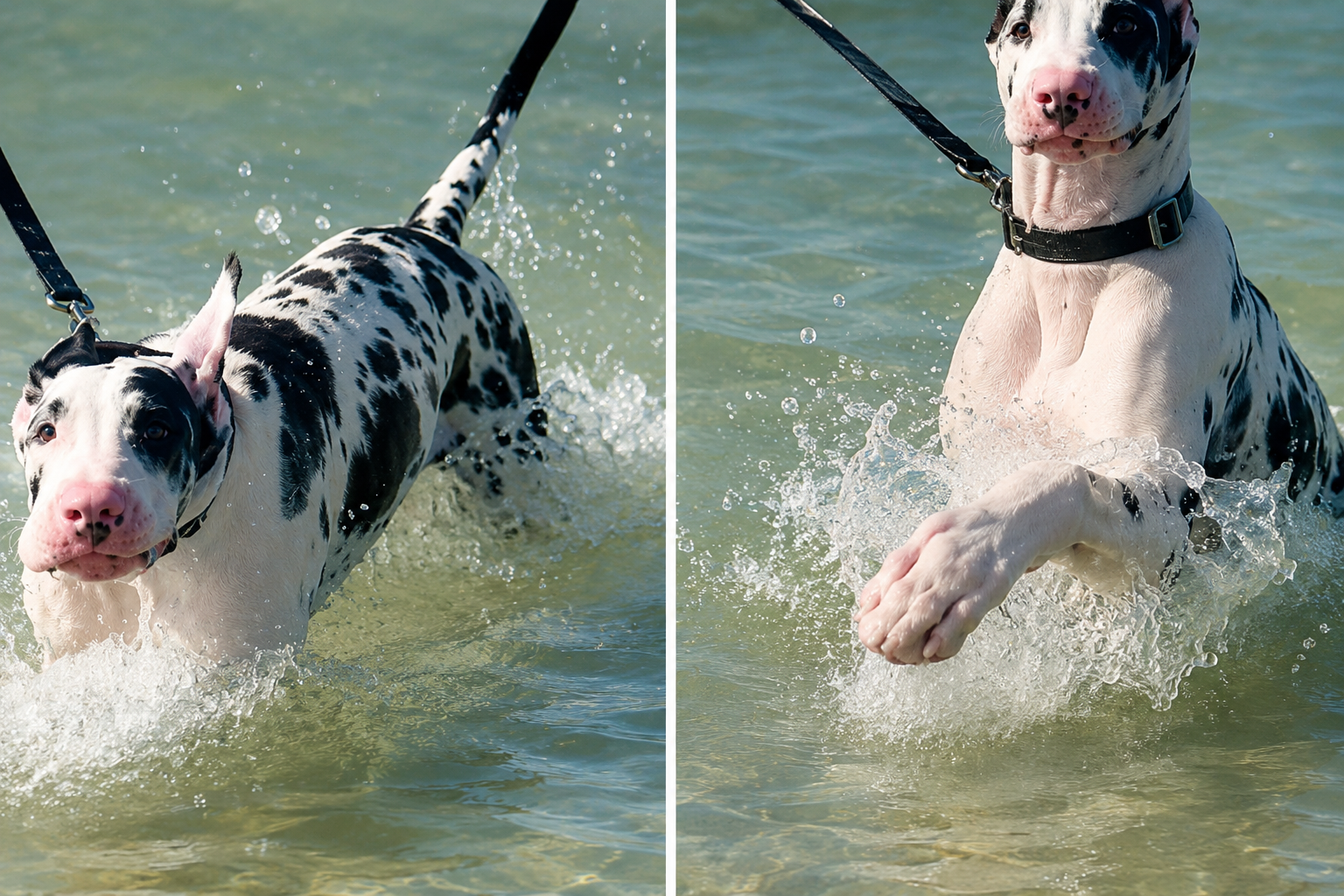
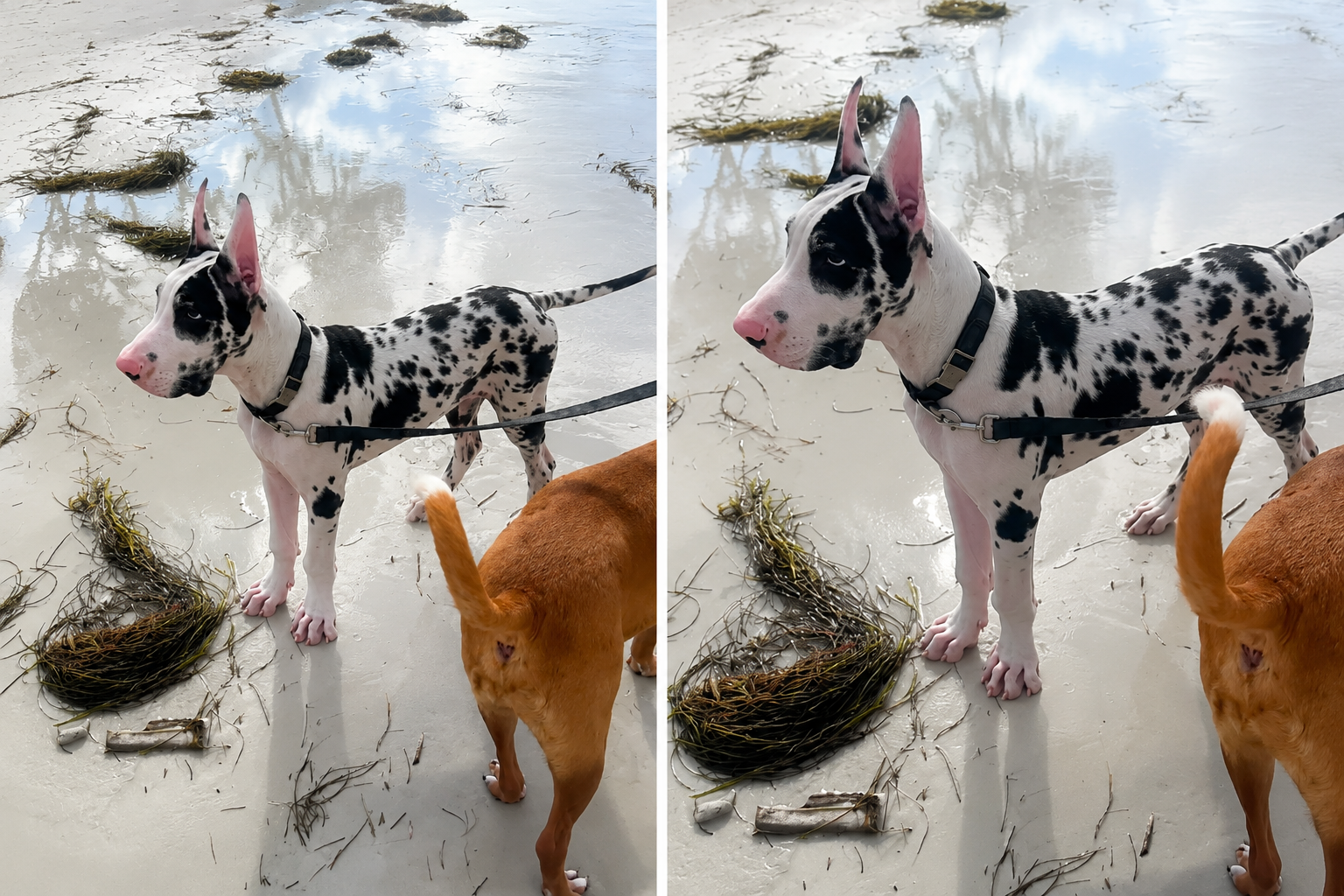
Recently I received videos of Kratos, formerly Zeppelin from my Lady × Inferno litter, at the beach with his mom. He was jumping through the waves, completely thrilled with himself, and apparently took to the water immediately—just like Lady.
My first thought was that dock diving might be in this dog's future.
My second was: This is exactly why I do this.
Kratos doesn't live with me, but that doesn't mean I handed him over and will see him again in two years if I decide I need a stud dog. His family and I are raising him together, with different roles, and I'll remain involved throughout his development.
A Guardian Puppy Is a Prospect, Not a Breeding Dog
This distinction is probably the most important part of my program.
Placing a puppy in a guardian/co-owner home does not mean I've decided at four months old that this dog should reproduce.
Quite the opposite.
I may see qualities in a puppy that I really like—structure, temperament, confidence, movement, trainability, pedigree—but puppies change tremendously as they mature. There are things I simply cannot know yet.
So for approximately the first two years, we're gathering information.
How does the puppy mature physically? What does his adult temperament look like? How does he respond to training and new environments? Are there any health concerns? Does his structure develop the way I hoped? What strengths does he have? What weaknesses?
And perhaps most importantly: does this dog have something valuable to contribute to the next generation of Great Danes?
If the answer eventually becomes no, nothing terrible happens.
He goes on being somebody's dog.
There is no failure in that. The family has a well-loved companion who has spent his life in their home, and I've learned something valuable for my breeding program.
What Does the Family Do?
For everyday purposes, this is their dog.
The dog lives with them, sleeps in their home, goes on vacations, plays at the beach, steals their spot on the couch if they allow such criminal activity, and becomes part of their family.
The guardian family is responsible for normal pet ownership and routine veterinary care. They're also responsible for keeping the dog healthy, appropriately conditioned, trained and available when needed for agreed-upon evaluations, health testing, certifications and, if ultimately selected, breeding.
I don't expect these dogs to spend two years sitting on a shelf waiting to see whether I breed them. I want them doing things.
That might mean obedience, conformation, rally, dock diving, Fast CAT, scent work or another sport that suits that particular dog and family.
Titles aren't just letters behind a dog's name. Working toward them gives me another opportunity to evaluate temperament, trainability, physical ability and how that dog performs outside his own backyard.
And frankly, it's fun.
What Is My Role?
I remain involved.
With Kratos, for example, I've already completed three training sessions with his mom through a combination of remote training and meeting in person at Petco in Port Richey.
Over the next couple of years, we'll continue that relationship. I'm available as a resource for training and development, and I get the opportunity to watch him mature instead of seeing him again at two years old and trying to evaluate the finished product.
When the appropriate time comes, I cover the health testing and certifications required specifically for evaluating the dog for my breeding program. Depending on the dog, that may include genetic testing through Embark or Optimal Selection, PennHIP, OFA evaluations and other testing appropriate to the Great Dane.
If I want a particular certification, evaluation or breeding-related procedure because of my program, that expense belongs to me—not the guardian family.
Routine veterinary care and the normal expenses of owning a dog remain the family's responsibility.
What Happens If the Dog Passes Everything?
Health testing is only one piece of the puzzle.
A dog can have beautiful health results and still not be a dog I want to breed. Likewise, titles don't automatically earn a dog a place in my program.
I'm looking at the whole dog: health, structure, temperament, pedigree, longevity within the family, trainability and what that individual could potentially contribute to the breed.
If, after maturity, health testing and evaluation, I decide the dog belongs in my program, then we move into the breeding portion of our agreement.
At that point, the guardian family is compensated for the dog's participation in my breeding program according to the terms established in their individual contract.
For females, my program is intentionally limited. A female may participate in up to two litters, with compensation to her family potentially totaling the original value of the dog over the course of that agreement.
Males work a little differently.
A male may have the opportunity to remain available as a stud beyond the initial breeding agreement if he develops into an exceptional representative of the breed and there is appropriate demand for him. Because the value and opportunities of an individual stud dog can vary considerably, those terms are established individually. His family may receive a percentage of stud income or other agreed compensation for his continued participation.
And there's an added incentive to do something with these dogs rather than simply own them.
As a dog earns meaningful titles and demonstrates his abilities, his value as a potential breeding dog may increase. When applicable, the guardian family's compensation can reflect their contribution to developing and proving that dog.
I don't want families simply housing breeding dogs for me. I want them invested in seeing what their dog can become.
What If I Decide Not to Breed the Dog?
Then the breeding portion of our relationship ends.
That's it.
Maybe the hips aren't what I wanted. Maybe something appears in the health testing. Maybe the adult structure isn't quite right. Maybe temperament develops differently than expected. Or maybe I simply have another dog who is a better match for where I want the program to go.
Selecting against breeding a dog doesn't mean there's something wrong with that dog.
A wonderful pet and a breeding-quality dog are not the same standard.
The entire reason for evaluating these dogs over time is so that I can say no.
Preservation breeding isn't about finding reasons to breed the dogs you own. It's about being willing to remove dogs from consideration when breeding them isn't the best choice for the next generation.
Why I Prefer This Model
A breeding program can reach a point where you simply cannot give every dog the individual life you want them to have if every potential prospect lives under one roof.
Guardian and co-owner homes allow me to preserve promising puppies from my litters without collecting dogs.
Kratos gets his person.
He gets beach days. He gets individual attention. He gets opportunities that might reveal talents I never would have discovered otherwise.
Meanwhile, I get to watch him grow, support his family, evaluate him over time and potentially preserve what I love about him for another generation.
And if breeding never becomes part of his future?
He still got the life I wanted for him.
That's the point.
It's incredibly difficult to hand over a puppy I've raised, trained and fallen in love with, particularly when I see qualities that make me excited about his future.
Then his mom sends me a video of him launching himself through ocean waves at four months old, having the absolute time of his life.
And I think, Yep. I put you exactly where you were supposed to be.