
The Most Controversial 2-Letter Word in Dog Training (Part 4 of 4: Where This Actually Leaves You)
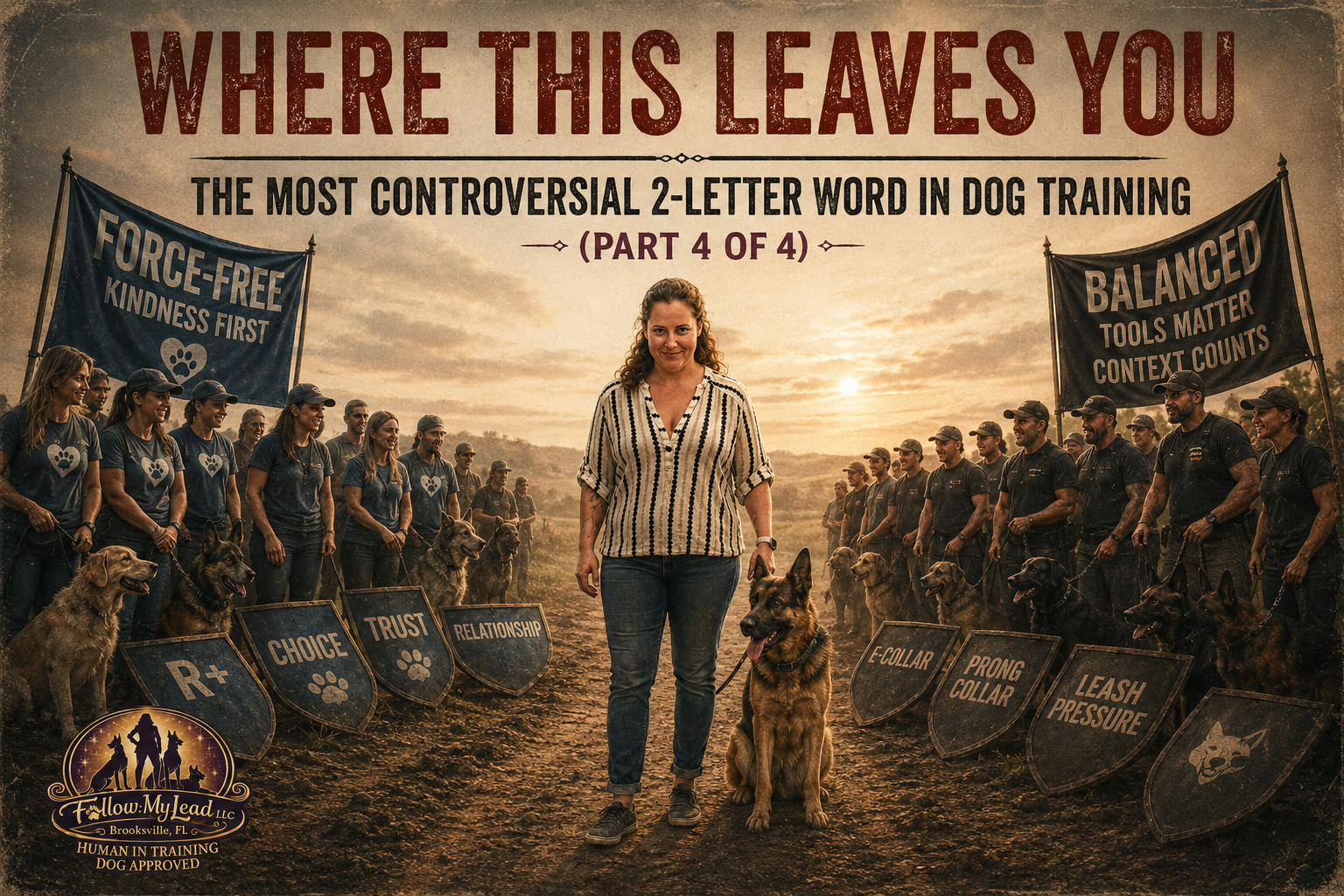
Previously: we watched a training-philosophy disagreement turn into an actual policy war, complete with real breed bans, a real viral feud between two guys who shouldn't have had a platform in the first place, and real dogs paying the price when the conversation broke down entirely. If you're just catching up, that's Part 3, the one with the XL Bully numbers and the Great Dane owner headed for shoulder surgery.
This last one comes back down to earth. Less policy, less history, more "okay, so what do I actually do with my own dog." It's also the most personal piece of the four — where the tool matters less than who's holding it, and where I've personally ended up after spending this entire series picking apart four different camps.
Who's holding the tool
This is where the "no aversives, ever, regardless of who's using them" framing misses the variable that actually matters: skill.
A tool doesn't carry a fixed moral value independent of the hand holding it. Give a hammer to a carpenter, they build a house. Give the same hammer to a kid with zero sense of force or timing, and something's getting broken — possibly the kid. The tool didn't change. The skill did.
Same story with an e-collar, a prong collar, a leash correction. In the hands of someone who understands timing, intensity, and that specific dog's threshold, it becomes a precise, low-stress way to build reliability — often with a lot less overall stress than the vague, inconsistent handling it's being compared against. In the hands of someone without that skill — using the tool out of frustration, bad timing, too much intensity — it doesn't teach anything. It damages. It can build the kind of deep, generalized fear that outlasts the behavior it was meant to fix and follows the dog for years.
One specific claim I hear a lot, and want to push back on directly: that a prong collar digs into a dog's neck and punctures the skin. In all my years training, the only time I've ever seen that kind of injury is from a collar left on 24/7, which is never proper use — a prong collar is meant to go on for training and come off after, not stay on all day, every day. That kind of injury comes from prolonged pressure and friction from constant wear, not from the mechanics of an actual correction. A prong collar works by distributing pressure evenly around the neck when the leash is tugged; it doesn't dig in and sink into skin the way it gets described online. Dr. Daniel Kamen, a canine chiropractor, made a similar clinical observation in his book The Well Adjusted Dog: he found far fewer upper cervical injuries in dogs wearing prong collars than in dogs on choke chains or misused flat collars, because the design spreads pressure out instead of concentrating it in one spot. That's a real clinical claim worth knowing, not a large-scale controlled study — and there's genuine disagreement among vets and behaviorists on this, so it's not a settled debate either way. Misuse causes real harm, and I'm not pretending otherwise — but the specific mechanism people describe usually isn't how the tool actually functions when it's used the way it's meant to be used.
I use a prong collar where it's appropriate — it's not my go-to, and it's definitely not my default for every dog that walks through the door the way it is for some trainers I know, whose whole approach seems to be: you own a dog, that dog gets a prong. That's not how I operate. LIMA is the standard I actually work from.
Separately, and worth naming plainly on its own: tools like prong collars and e-collars keep getting restricted not because the evidence settled anything, but because certain camps — force-free chief among them — have pushed positions extreme enough to actively lobby for outright bans, deciding for everyone else which methods are still allowed to exist. AKC banning these tools from all of its events and grounds entirely — not just the show ring, whether you're actually competing that day or not — is one visible example of that pressure. That's the exact moment this stops being a methodology debate and becomes a welfare issue instead — because it's no longer trainers disagreeing over the best approach, it's one side removing the other side's ability to choose at all.
A position statement that treats the tool as the variable, instead of the skill of the person holding it, is measuring the wrong thing entirely. Banning the hammer doesn't make an unskilled carpenter safe to be around, and it doesn't make a skilled one worse at the job. It just removes a tool that, correctly used, was never actually the problem.
The other extreme: when aversives go wrong
Everything above assumes the tool's being used well. Let's be equally honest about what happens when it isn't — because a dog raised with zero boundaries and a dog raised under badly applied punishment can land in the same bad place. They just take different roads to get there.
It usually starts with wanting a shortcut. Someone picks up a tool hoping for instant gratification — press the button, behavior stops, done, go home. In trainer circles this gets a name: "shock jock" — someone who thinks any behavior problem can be solved by strapping on an e-collar and delivering a high-level correction with no warning, no prior conditioning, and no attempt to actually explain to the dog what's happening. Paw touches the counter, dog gets a level 100 correction, no buildup, no marker, no context. But a dog doesn't experience a correction as a surgically precise edit to one specific behavior. Get the timing, intensity, or context wrong, and the dog can misread exactly what's being punished. A correction meant to stop reactivity toward another dog, delivered half a second late, can teach the dog that the other dog is the problem. Congratulations, you didn't fix a reactive dog — you built a dog that's now genuinely afraid of other dogs in a way they never were before your "fix." Not a fluke. That's the predictable result of using a tool without the skill to control what it actually gets paired with.
Same failure, different source, shows up in trainers themselves. An overly aggressive trainer who isn't reading the dog throughout a session isn't training — they're overwhelming. A dog under that much stress isn't learning anything; they're just surviving the session. What looks like suppressed behavior often hasn't gone anywhere. It's just been shoved underground, and it tends to resurface later — bigger, and with a lot less warning than the original behavior ever gave you.
Push it far enough and you get learned helplessness: an animal subjected to punishment it can't predict or escape eventually stops trying to change its own outcome, even in situations where escape or the correct response is genuinely available. That's not calm. That's not obedience. That's a dog that's learned nothing they do matters, so they've quit trying.
This is what I see most often from trainers and owners chasing a quick fix: a dog that performs, but only under the threat of punishment, with zero enthusiasm behind it. Take the tool away and the whole thing falls apart, because the dog was never actually taught the behavior — the dog was taught to avoid a consequence instead, and knows the difference perfectly even when the handler doesn't. You can spot it on sight. Flat. Mechanical. No joy in it whatsoever. Nothing like a dog that actually wants to be right. That flatness is the tell. The dog is telling you exactly what kind of relationship you're in, whether you're willing to hear it or not.
If we don't teach the boundary, the world will
Here's a version of this argument that doesn't get made nearly enough: teaching a dog "no," or an off-switch, or whatever you want to call it, isn't optional cruelty. It's protection. A dog who never learns that some things simply aren't allowed doesn't get to skip that lesson forever — they just end up learning it from something with a lot less mercy than a trainer or an owner. A door left open, a dog that's never been taught not to bolt through it, and a road on the other side will teach that lesson permanently, in a single instant, with no do-over.
I'd rather be accused of being too firm and have a dog that understands a door isn't an invitation, than have a dog that finds that boundary for the first time in the path of a truck. That's not a controversial position. That's just what taking a dog's safety seriously actually looks like once you stop arguing ideology and start thinking about consequences — the real kind, not the training-theory kind.
Where I am now
I've been watching this stuff since I was a kid glued to Animal Planet, long before I ever had a training philosophy of my own to defend. So my influences aren't clean — they're a mess of names from every camp in this article, including plenty of people I'm not actually aligned with anymore.
I started my own business in 2018, and that's really when the balanced side of my education kicked into gear — I didn't touch e-collar or prong work myself until after 2020. Most of what I know about e-collar mechanics didn't come to me directly from Ed Frawley, Michael Ellis, or Bart Bellon — it came filtered through trainers like Larry Krohn, Sean O'Shea, and Tom Davis, who I believe built a lot of their own foundation on what Frawley, Ellis, and Bellon developed. I've never trained formally in NePoPo or sat in a Leerburg classroom; what I have is bits and pieces picked up over years of following the people who did, the way most of us actually learn a skill set — secondhand, in fragments, filtered through whoever's teaching happened to reach you first. Mark McCabe's Training Between the Ears came into my world around this same time, too — his whole system is built around actually shifting what's going on behaviorally and emotionally for the dog, not just getting cleaner obedience, and that distinction has stuck with me ever since.
Then swing all the way to the other end, and Patricia McConnell's books were some of the first serious reading I ever pulled from a library shelf on why dogs actually do what they do. Emily Larlham's Kikopup channel and Susan Garrett's work in the dog-sports world taught me that motivation and drive-building aren't a force-free-only concept — a dog that's genuinely fired up to work is a dog any camp should want. Michael Shikashio and the Aggression in Dogs Conference gave me a different education entirely, on how much more carefully real aggression cases have to move. And modern cognition research — Claudia Fugazza's social-learning work, Brian Hare's studies on how dogs read human gestures in ways wolves simply can't — keeps proving there's more going on in a dog's head than any of the four quadrants alone can explain. That's a much bigger conversation than this article has room for, and one worth coming back to on its own.
None of these people agree with each other. Several of them would probably bristle at being named in the same paragraph. I've pulled something real from all of it anyway, and I keep doing it, because the thirst for a better answer doesn't stop just because you've settled on a philosophy. That's really the point of this whole piece. You don't have to compete in the same sport, write in the same camp, or even like each other, to have built something worth another trainer's attention.
What I've learned from both sides
The real limitation of my force-free years, I understand now: without a marker that carries genuine meaning for that specific dog, the message never lands — and "meaningful" isn't the same across every dog. What lands clearly for one does absolutely nothing for another, or hits far harder than you intended. LIMA earns its name when someone actually practices it instead of just quoting it at people online. It's not a two-quadrant rule, and it's not a free pass either. It's a discipline: look at the dog in front of you, understand what they're actually sensitive to, and choose whichever tool is least aversive while still being effective enough to change the behavior you're trying to change.
I believe people can learn from both sides of this without it turning into a war — if we're actually willing to listen instead of just waiting for our turn to talk. You can disagree with someone completely, not even particularly like them, and still learn something real from what they've seen. That's not me splitting the difference to keep the peace. It's just what taking the dog's welfare seriously, instead of taking your own camp seriously, actually requires.
I've drawn something usable from all three camps in this piece, not just two. Force-free taught me to get creative instead of reaching for a correction first. The old-school world's "nothing in life is free" quietly became "Learn to Earn" in force-free hands — same structure, friendlier name, proof these camps aren't as far apart in practice as they sound in an argument. And even people whose public conduct genuinely rubs me the wrong way can hand you something worth keeping — I still use the Supernanny comparison with clients, the same insight Victoria apparently built a whole show on, because it's just true regardless of who says it. You don't have to like someone, or agree with them on much of anything, to recognize when they've landed on something real.
How I actually use markers
Here's where I land in practice, for what it's worth — other trainers do this differently, and that's not a right-or-wrong thing, it's just my system.
I use five words, and each one is a promise, not a mood. Yes means reward, every single time — no exceptions, no "close enough." Good is praise, keep going, you're on the right track, no payment attached. No is a warning — paired with something like leash pressure, it means "wrong answer" or "you're about to make a choice you're not going to like." Quit is the mirror image of yes: it means punishment, every single time, with exactly the same certainty that yes means reward. And free is my terminal release — it means you're done, off the clock, go be a dog for a while.
What actually changes from dog to dog isn't the word or the rule behind it. It's what counts as reward and what counts as punishment for that particular dog. The marker system stays constant. The value underneath it gets personalized.
What this means for your dog
None of this has to stay theoretical. If you want "no" to actually mean something in your house, here's the short version:
Pick a tone and stick with it. Not angry, not pleading — just clear and matter-of-fact, the same way every time, so your dog isn't also trying to decode your mood on top of the word.
Pair it with something. A "no" that isn't followed by anything — no redirection, no consequence, nothing — teaches your dog it's just a sound you make sometimes. Give the dog something else to do, or make it clear there's an actual consequence for continuing, so the word starts predicting something real.
Don't spend it on everything. Save "no" for the things that genuinely matter — real boundaries, real safety issues — and use redirection or a simple "ah-ah" for the small stuff. Give the remote-chewing and the running-toward-traffic the exact same word at the exact same intensity, and your dog has no way to tell them apart.
Watch what your dog is actually telling you. A dog that flinches, shuts down, or avoids you after a correction isn't learning what you think they're learning. A dog that pauses, reorients to you, and tries something else is. That difference matters a lot more than which camp you technically belong to.
You don't need a training philosophy to get this right. You need consistency, clarity, and a willingness to actually watch your dog instead of just talking at it.
If you've read all four parts of this series, you already know I don't believe in one-size-fits-all training — every recommendation in here still comes down to the dog actually in front of you. If you want a plan built around your dog specifically, book a private lesson if you're in Hernando County, or reach out about remote coaching if you're not.
That's the whole series. Four parts, one two-letter word, and a lot more history behind it than anyone arguing about it in a comment section usually bothers to learn. If you've made it all the way from the panties-in-a-knot opener in Part 1 to here, you're exactly the kind of person this was written for — the ones who actually want the whole picture instead of picking a side and calling it a day.