
When Love Isn't Enough: Understanding the Science Behind Canine Aggression

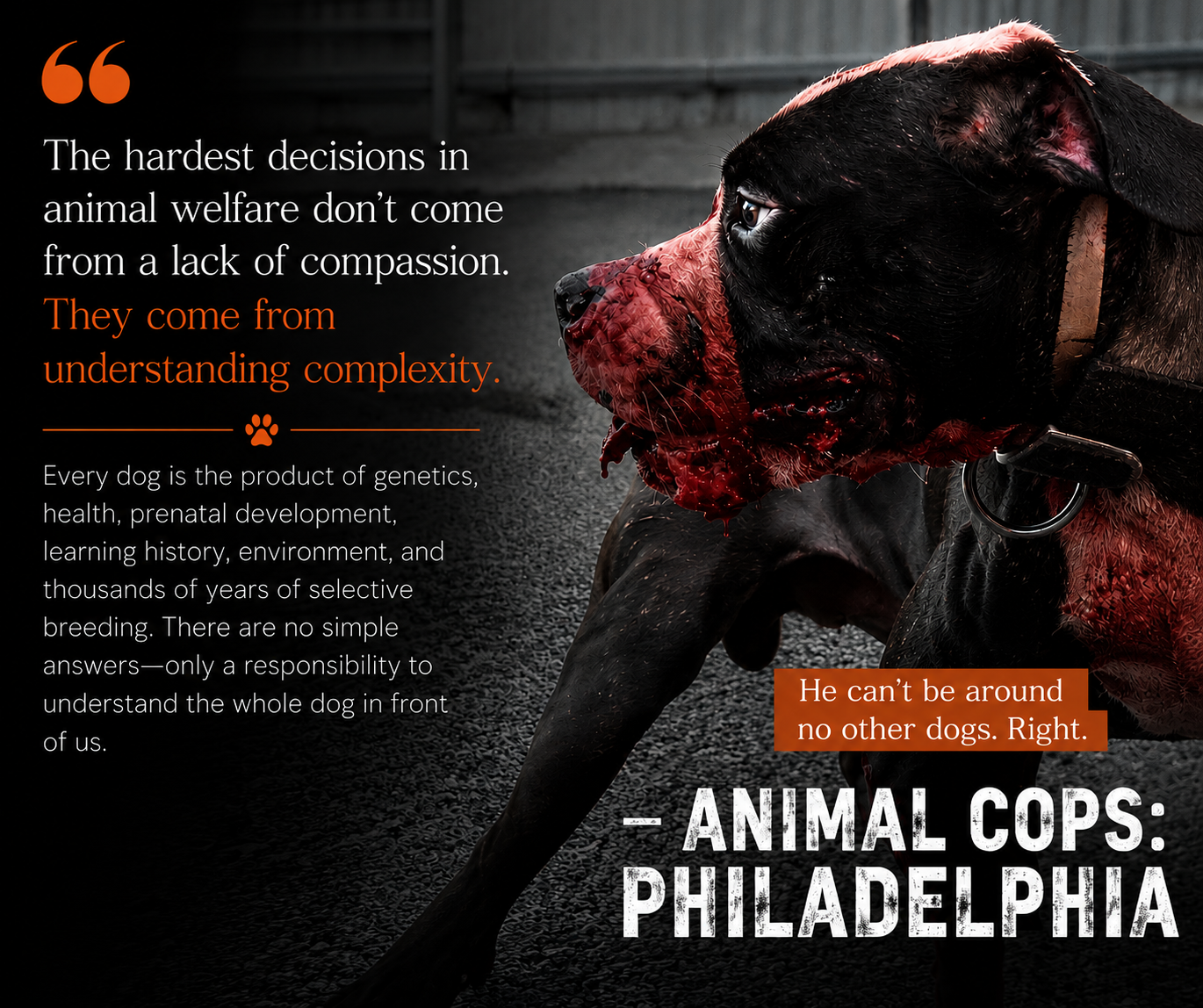
Recently I watched a clip from Animal Cops: Philadelphia documenting one of the hardest decisions animal professionals sometimes have to make. Naturally, I also made my way to the comments to see what people generally had to say about it — and the wild array of takes never disappoints.
The clip only showed part of the story, so I'm not going to pretend I know everything that happened before this dog arrived at the shelter. What it did show was a pit bull-type dog brought into the facility and placed in a kennel. At some point, the dog ripped through the metal and plastic barriers separating the kennels and got into it with the dogs housed beside him — tearing himself up badly in the process, and almost certainly doing the same to them. The clip didn't go into detail on any of that. It just panned over to the blood all over the kennel by the time staff were able to intervene.
The shelter ultimately determined they couldn't safely house him anywhere near other dogs and made the heartbreaking decision to perform a behavioral euthanasia.
What caught my attention wasn't the decision. It was the discussion that followed.
The narrator explained that the dog had been "conditioned to tolerate extreme amounts of pain." Almost immediately, the comment section split into two camps: one insisting the dog had been abused or traumatized into becoming this way, the other insisting all pit bulls are simply born dangerous. Watching both sides argue, I realized they weren't actually discussing what happened to this dog. They were debating two completely different stories they'd invented to explain his behavior — neither of which anyone in that comment section actually had the evidence to tell.
That scattershot reaction points to something bigger than one video. It points to a fundamental lack of understanding about what actually makes dogs tick — and a habit of relating to dogs through a personified, almost fantasy version of who we imagine they are, instead of who they actually are as a species. Give people a dog they don't understand, and they'll fill in the gaps with whichever story feels most satisfying, whether that's "he was tortured into this" or "his kind is just born broken." Neither one requires you to sit with the discomfort of not knowing.
That happens a lot in the dog world.
Looking for Simple Answers
Social media has a way of convincing us there are only two possible explanations for anything.
One side believes every aggressive dog is simply a victim who lacked love, needed a different owner, or just hadn't found the right trainer yet. The other believes certain breeds are genetically destined for this behavior and that the breed itself is the problem.
Neither position reflects reality. Behavior is more complicated than a 30-second clip and a comment box can hold, and that's exactly what makes these conversations so difficult.
Over the years I've attended conferences and seminars taught by professionals across a range of disciplines — people who spend their careers elbow-deep in exactly this question. One thing has always stood out to me: although they don't agree on much when it comes to training methods, they agree on something more important. Behavior is multifactorial.
The further I got from social media and the closer I got to rooms full of experienced professionals, the less I heard anyone arguing about whether behavior comes from genetics or environment. Instead, the conversation centered on how genetics, health, development, learning, and environment interact to create the dog standing in front of us.
That's a much more interesting conversation. It's also a lot harder to fit into a comment box, which is probably why nobody's having it there.
Not All Aggression Is the Same Aggression
The shelter dog's case was the real thing. He wasn't posturing or bluffing through a barrier — he tore through it to get at the dogs on the other side, and by every indication, his intent was to seriously hurt or kill them. That does happen, and it's part of why the shelter made the call they did. But it's worth being clear that this level of aggression is not the norm, because most aggression between dogs isn't anything close to it.
Dr. Pachel makes a point in his work that's worth sitting with here, precisely because it's the contrast to a case like this one: aggression is very often ritualized, and ritualized aggression is a completely natural, normal part of being a dog. Most of what looks alarming — the growling, the snarling, the snapping, the lunging, all the noise — is communication, not an attempt to inflict serious damage. It might be inappropriate. It might need to be addressed. But the dog's actual intent in most of those moments isn't to kill or maim, even when it looks and sounds like it could be. Dr. Pachel draws the comparison to how humans ritualize aggression too. Watch two lawyers going at it in a courtroom, all raised voices and pointed fingers and barely-contained agitation — it looks plenty intimidating in the moment, but nobody in that room is actually trying to kill anybody. Hopefully.
That distinction matters because it's exactly what gets lost in a comment section. People see a dog snarling and assume "vicious" and "trying to kill" are the same thing, when a huge percentage of aggressive displays never even make contact, let alone cause real damage. This is part of why professionals use tools like Dr. Ian Dunbar's bite scale, which measures the severity of an actual bite on a six-point scale — from aggressive behavior with no skin contact at all the way up to a bite that causes fatal injury. The scale exists because "my dog bit someone" covers an enormous range, from a nip that left a light scratch to a bite that required surgery, and those two things call for very different responses. The level of commitment behind a bite tells you far more than the fact that a bite happened at all — which is also exactly why the shelter dog's case stood out. It wasn't ritualized. It wasn't posturing. It was the rare case that actually lived up to the worst assumptions people make about ordinary dog aggression every day.
Just as important as the severity itself is the context around it. What triggered the incident? Was there a warning first — a freeze, a growl, a hard stare — that got ignored? Was this a fight over resources, a startle response, redirected arousal, fear, or something the dog had been building toward for a while? Some of those triggers are ones a handler can identify, manage, and train around going forward. Others aren't. That's the actual work behind a case like the shelter dog's — not just "how bad was the injury," but "what caused this, and is that something we can realistically change." Skipping straight to a verdict, the way that comment section did, skips the only part of the process that actually tells you anything useful.
It Takes More Than One Discipline to Understand a Dog
One of the biggest changes in my own career came when I stopped looking for one person with all the answers and started learning from people with very different backgrounds and areas of expertise. The more I learned, the more I realized they weren't contradicting each other nearly as often as social media would have you believe. They were simply looking at the same dog through different lenses.
Ethologists, like Kim Brophey, help us understand why dogs behave the way they do by studying evolution, breed purpose, genetics, and natural behavior. Ethology is the piece people forget most often — the idea that breeds weren't randomly created. Humans selectively bred them for specific jobs, and those inherited instincts are still part of the dogs we live with today, whether or not that dog will ever do the job it was built for.
Veterinary behaviorists, such as Dr. Karen Overall, Dr. Chris Pachel, and Dr. Meghan Herron, help us understand the biology behind behavior. Their role isn't simply prescribing medication. They evaluate whether pain, neurological disease, endocrine disorders, cognitive decline, anxiety disorders, compulsive disorders, or other medical and psychological conditions are influencing a dog's behavior. Just as people can develop psychiatric illnesses, dogs can develop behavioral disorders that change the way they perceive and respond to the world around them. In those cases, medication isn't a replacement for training. It can reduce the emotional or neurological barriers that prevent a dog from learning so that training has a chance to be successful. Likewise, if a dog is painful, no amount of obedience is going to fix a herniated disc or an arthritic hip.
Aggression specialists, like Michael Shikashio, focus on understanding the motivation behind aggression, assessing risk, reading body language, and designing behavior modification plans that prioritize both safety and welfare.
Shelter behavior experts, like Trish McMillan, evaluate dogs from cruelty cases, hoarding situations, dogfighting investigations, and shelters. They also face some of the most difficult decisions in our profession, balancing public safety, quality of life, available resources, and the welfare of every animal in their care.
Working dog trainers, including professionals such as Ivan Balabanov, Jay Jack, Larry Krohn, Sean O'Shea, and Tom Davis, bring another valuable perspective. They spend their careers evaluating drive, nerve, resilience, confidence, thresholds, and how inherited traits influence a dog's ability to perform specific jobs. They understand that training can refine genetics, but it cannot create traits that were never there in the first place.
The reason I mention these different disciplines isn't because I expect every dog owner to recognize the names. It's because every one of them has helped me understand a different piece of the puzzle.
Ethologists explain why a behavior exists. Veterinary behaviorists explain how health, the brain, and the body influence behavior. Aggression specialists teach us how to safely evaluate and modify behavior. Shelter professionals remind us that quality of life, public safety, and available resources are all part of difficult behavioral decisions. Working dog trainers demonstrate what inherited traits look like when they are carefully selected, developed, and refined over generations.
When you put those perspectives together, you begin to see the whole dog instead of searching for a single explanation. Behavior isn't just genetics. It isn't just environment. It isn't just training, health, or life experiences. It's the interaction of all of those factors, which is why reducing aggression to a single cause almost always misses the bigger picture.
Genetics Provide the Blueprint
Genetics provide the blueprint, but a blueprint isn't a finished house. From the moment of conception, that blueprint starts interacting with everything the dog experiences — the environment in the womb, maternal health, nutrition, early development, learning, training, medical conditions, and life experience. Behavior isn't created by one thing. It's the result of genetics interacting with everything that happens before and after birth.
At the same time, there are limits to what experience can change. You can't make every Labrador Retriever into a service dog. You can't make every German Shepherd into a police dog. You can't make every Border Collie want to herd sheep. Even within those breeds, selection matters — the same is true within individual bloodlines and even within the same litter.
Great Danes are one of my favorite examples. They were originally developed to hunt wild boar. If you've met my dogs, you understand exactly why that makes me laugh — mine couldn't take down a wild boar, and I'm not convinced they could take down a turkey. The gumption just isn't there anymore. Hundreds of years of selective breeding changed what those dogs looked like and, more importantly, how they behave. (I write more about how I select for temperament first, ahead of health, structure, or looks, in Picking the Perfect Dane Puppy — it's the same logic at work here, just pointed at puppies instead of shelter dogs.)
The point is that genetics don't just create breeds. They create bloodlines, families, and individuals. Two dogs can belong to the same breed and have very different temperaments, drives, thresholds, confidence, and resilience because they descend from generations of selection for different purposes.
This is worth pausing on with "pit bulls" specifically, not because I want to make this whole piece about that debate, but because so much of the internet argument happens without anyone agreeing on what they're even arguing about. "Pit bull" isn't actually a breed. It's an informal catch-all for any dog with a certain blocky head and build — American Pit Bull Terriers, American Staffordshire Terriers, American Bullies, and any number of mixes that just look the part. Under that one umbrella term you've got several genuinely different breeds, each with their own history and selection pressures, and then within each of those breeds you've got individual bloodlines that vary just as much as the Labrador or German Shepherd examples above. In genetics terms, that's phenotype (what you can see — the blocky head, the build) versus genotype (the actual genetic makeup underneath), and two dogs can share the first while being worlds apart on the second. That's exactly why you see someone post a photo of their "pibble" — who is, in this specific dog's case, afraid of his own gas, currently snoring on the couch in a pair of custom footie pajamas, cuddled up to his stuffed yellow ducky — captioned with something like "how could anyone hate this breed?" Both things are true at once. That dog is genuinely that soft. And a dog from a very different bloodline, bred and in some cases deliberately conditioned for entirely different traits, can look almost identical to him standing at the fence. Lumping them all into one label based on how they look is exactly the kind of oversimplification this whole article is arguing against.
Development Starts Before Day One
Genetics aren't the only thing already in motion before a dog ever meets you. Some of it starts before the puppy is even born. A stressed or malnourished mother during pregnancy can pass stress hormones to her developing puppies, and there's documented evidence of this playing out in rescue situations — puppies born to mothers who went through extreme stress or malnutrition during pregnancy showing lasting effects on temperament and stress reactivity even when the puppies themselves were raised afterward in ideal conditions. The damage, or at least the shift, was already done before birth. It's part of why breeders who take this seriously put real effort into keeping a pregnant mother calm, well-fed, and low-stress — and part of why a rescue's account of a dog's puppyhood is sometimes only half the story. Dr. Sophia Yin's Perfect Puppy in 7 Days covers the other side of that timeline — how what happens to a puppy in the days and weeks after birth, well before you ever bring her home, already shapes the dog she becomes.
The first twelve weeks after birth matter just as much. This is the window programs like Puppy Culture, developed by breeder and trainer Jane Killion, are built around — structured early neurological stimulation, socialization, and enrichment during the specific developmental periods where a puppy's nervous system is primed to learn resilience instead of just reacting to the world. It isn't about producing a puppy who's never stressed. It's about giving a puppy small, appropriate doses of novelty and mild stress early, on purpose, so the dog that comes out the other side handles the real world's much bigger stressors better. A puppy raised without any of that structure isn't doomed, but a puppy raised with it starts life several steps ahead — which is one more reason "nature versus nurture" was always the wrong framing. The two are tangled together from before day one.
Health Is Part of the Equation Too
Understanding genetics doesn't mean ignoring everything else.
Pain changes behavior. Hormones influence behavior. Nutrition can influence behavior. Learning shapes behavior. Environment matters. Medical conditions matter.
Dogs don't have the ability to tell us they have arthritis, a herniated disc, dental pain, an ear infection, or abdominal discomfort. They don't ask for aspirin or mention they've had a headache all week. Instead, they communicate through behavior. Dogs are also instinctively wired to hide weakness whenever possible, because in nature, vulnerability comes with consequences — nobody wants to be the limping gazelle.
If a dog's aggression appears suddenly or represents a dramatic change from its normal personality, that should always be a reason for a thorough veterinary evaluation before anything else. Thyroid disease, neurological disorders, chronic pain, cognitive decline, medications, and even prenatal development can all influence behavior.
The mistake is assuming every aggressive dog has the same explanation.
What "Conditioned to Tolerate Pain" Actually Means
This was the sentence that seemed to cause the most confusion in the video.
When the narrator said the dog had been conditioned to tolerate extreme amounts of pain, a lot of people heard: someone abused this dog until he became aggressive.
Those are not the same thing. Conditioning, selective breeding, and training are three completely different concepts that constantly get lumped together as if they're interchangeable.
Several years ago I attended the Aggression in Dogs Conference, where former ASPCA Field Investigations & Response behavior specialist Trish McMillan spoke directly to the "bait dog" myth — the assumption that any battered, dog-aggressive dog found on the street must have been used to build up a fighting dog's confidence. She shared an analogy that has stuck with me ever since: it's the equivalent of putting Mike Tyson in the ring with a two-year-old to make him a better boxer. It doesn't work like that, and it's not supposed to. Fighting dogs aren't made tougher by beating up on helpless animals — helpless animals don't teach persistence, gameness, or a fighting dog's threshold for pain.
The point wasn't that abuse has never happened. The point was that instinct isn't created that way. Part of what makes McMillan's perspective on this hard to argue with is where it comes from — her field investigation work has included interviewing convicted felons who ran fighting operations themselves, to understand how they actually select dogs rather than how the internet assumes they do. One of them told her you're lucky to get even one good "game" dog out of an entire litter. If conditioning could manufacture that trait, breeders running these operations wouldn't need to gamble on a whole litter to find it — they'd just condition whichever puppy they had. They don't, because they can't. McMillan's own case data backs this up in a way that runs opposite to what most people assume: far more dogs seized as puppies from fighting operations — dogs who were never actually exposed to fighting or used as bait — go on to develop serious dog-aggression than dogs who lived through that world and never show it. If exposure and conditioning were what created the aggression, that pattern should run the other way.
Historically, dogs used in organized dog fighting were selected over generations because they already possessed traits like persistence, determination, willingness to continue despite pain, and intense dog-directed aggression. Physical conditioning could improve athletic performance, but it couldn't manufacture instincts genetics hadn't already provided. You could condition and train a Shih Tzu from day one and you're still not getting a guard dog out of it — you're getting a very fit mop of hair who is extremely committed to yelling at the mailman.
That's a very different conversation than saying a dog was abused into becoming aggressive.
The Hardest Part of This Conversation
This brings us back to the shelter dog.
Many people in the comments believed he simply needed a home without other dogs. I understand why that feels like the compassionate answer. But compassion also has to account for reality.
What happens if someone forgets to latch the gate? What happens if a child leaves the front door open? What happens if the dog breaks through a fence, a window, or another barrier the same way he broke through a kennel wall? What happens when the neighbor is walking their dog at exactly the wrong moment?
Management plans don't fail because people are bad owners. They fail because people are human.
Could there be someone capable of safely managing a dog like this? Possibly. There are highly experienced handlers, specialized facilities, and protocols far beyond what the average home could provide. Those placements, however, are extraordinarily rare, and they aren't sitting empty waiting for the next dangerous dog to fill them.
Shelters also have a responsibility to every animal in their care. Every kennel occupied indefinitely by a dog who cannot be safely placed is a kennel unavailable to another dog with an excellent chance of rehabilitation and adoption. Every dollar spent managing one exceptionally dangerous case is a dollar that can't go toward medical care, rehabilitating fearful dogs, or countless other animals waiting for a chance.
That reality doesn't make behavioral euthanasia easy. It makes it heartbreaking. Sometimes the most compassionate decision isn't the one that keeps a dog alive the longest — it's the one that prevents further suffering, protects other animals and people, and recognizes that quality of life matters as much as quantity of life.
My Hope
If there's one thing I hope people take from this, it's that we stop trying to explain complicated behavior with one simple story.
Not every aggressive dog was abused. Not every pit bull shares the same genetics. Not every dog can be rehabilitated. Not every dog is beyond help.
Every dog deserves to be evaluated as an individual — considering genetics, health, prenatal development, environment, learning history, management, and the purpose that dog was originally bred to perform. It means asking questions before jumping to conclusions, resisting the urge to invent a backstory we can't possibly know, and accepting that the answer is rarely found at either extreme.
Dog behavior is messy. It's fascinating. It's heartbreaking.
And if we truly want to advocate for dogs, we owe them more than assumptions. We owe them a willingness to understand just how complicated they really are — even when that's a lot more work than picking a side in a comment section.
If you're dealing with a dog whose behavior doesn't add up — sudden aggression, a personality shift, or a case that doesn't fit the easy explanations — that's exactly the kind of thing worth getting a second set of trained eyes on before you diagnose it yourself from a Facebook thread. Reach out about behavioral training — in person in Hernando County or remotely from anywhere — and let's actually figure out what's going on with your dog, not just which story is easiest to believe.
Related reading: Heads Up — How to Avoid Bad Training Advice on Facebook, The Most Controversial 2-Letter Word in Dog Training