
Making Matches That Last: How I Screen My Puppy Buyers
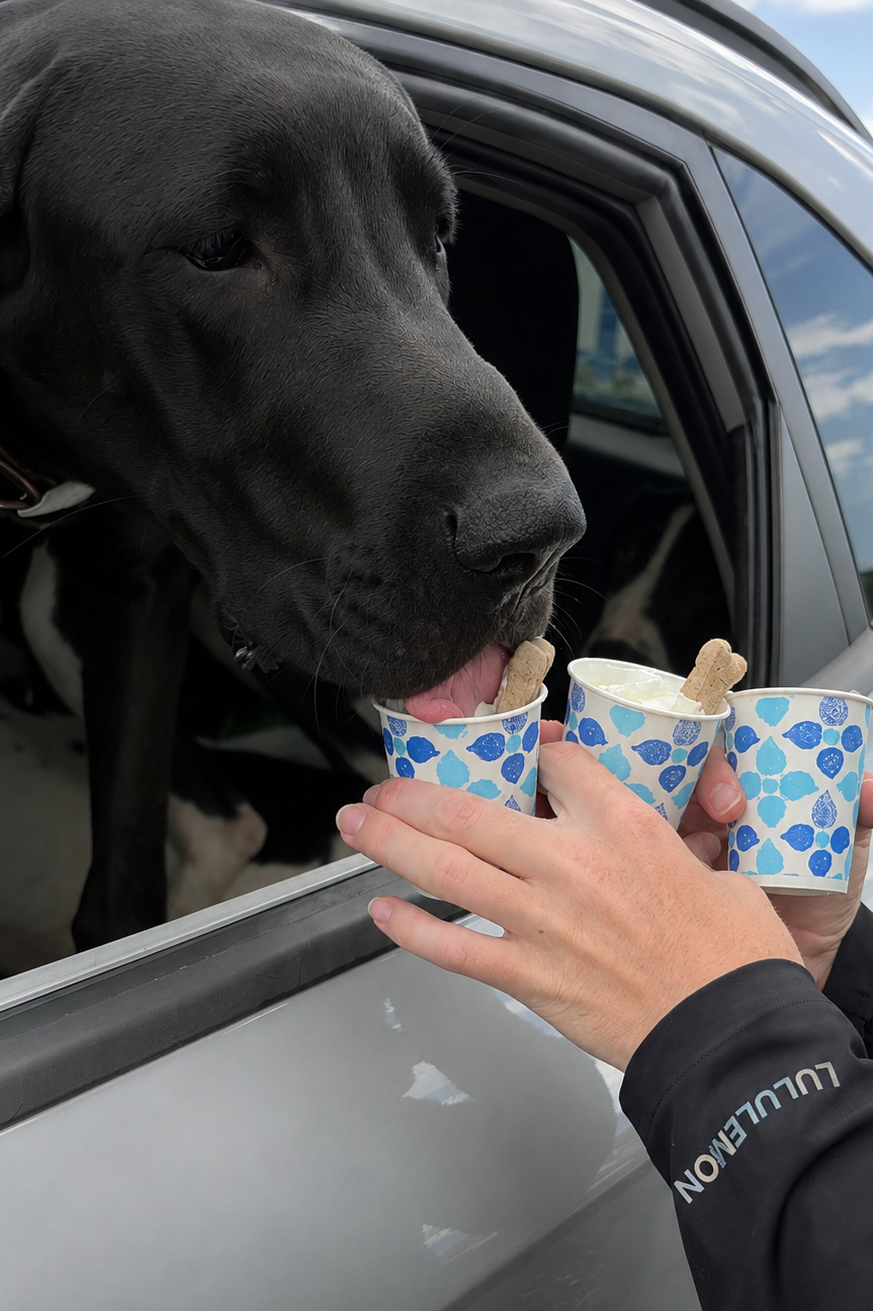
Follow My Lead’s Times Long Past, CGC “Eve” The Great Dane puppy, enjoying a Pup Cup
If you've ever filled out one of my puppy applications, you've probably noticed I ask a lot of questions.
To be honest, I don't enjoy that part of the process.
Not because I don't enjoy getting to know prospective puppy buyers — I genuinely do. Some of those conversations last well over an hour, and I love hearing about people's lives, their families, their past dogs, and what they're hoping for in their next companion.
What I don't enjoy is feeling like I have to be the bad guy. Nobody likes disappointing people, and being the person standing between someone and the puppy they've already fallen in love with is not exactly a fun Friday night.
Over the years, though, both as a breeder and as a professional dog trainer, I've learned that asking difficult questions before a puppy goes home is far easier than trying to fix a mismatch six months later.
Recently, I had one of those conversations.
Cindy and Eve
A wonderful woman named Cindy contacted me about Eve.
The interesting thing about Cindy's application was that there really weren't any obvious red flags. Quite the opposite — she had a lot of green flags. She was retired, worked from home, was financially stable, owned her own home with a large fenced yard, had decades of experience with Great Danes, already had another Great Dane, lived within a few hours of me if she ever wanted follow-up training or support, and was more than willing to continue training.
Honestly, if you were simply checking boxes on a puppy application, she was exactly the kind of home most breeders hope for. On paper, this should have taken about four minutes.
That's exactly why I think it's important not to rely solely on an application. Applications tell me about a person's circumstances. Conversations tell me about their life.
As we talked, I learned she'd lost her husband of more than 40 years. More recently, she'd lost her senior Great Dane. She still had Zelda, a three-year-old Dane she'd worked hard to train through some behavioral challenges, and she found herself thinking another puppy might be a good companion for both of them.
That's when I asked a simple question.
"Is getting another dog something that you would like... or is it something you think Zelda would like?"
She paused. She admitted she really didn't know. Zelda had tolerated her senior female, but she wasn't sure she genuinely enjoyed living with another dog.
That changed the conversation.
We talked about what life with a seven-month-old, nearly 100-pound puppy actually looks like. Eve is a wonderful dog, but she's still a puppy. She still needs daily structure, continued socialization, reminders about the rules, and ongoing training. Raising a puppy isn't just about enjoying the fun moments. It's about committing to the work that comes with them.
I also asked what support she had if she became sick or injured. Who would help with two giant breeds? Was she prepared to continue investing the time needed so both dogs could thrive instead of simply coexist?
Someone who's willing to help out because they enjoy dogs doesn't necessarily sign up so easily for a dog that's 140 pounds. Owning a Great Dane is a genuinely different experience than owning most other breeds, and it's one Cindy already knew well from Zelda. You have to really, and I mean really, like dogs. Everything about them is extra, not just the size — the food, the vet bills, the space they take up on the couch, the sheer logistics of managing two of them if one goes down. A friend or family member happy to walk a Lab around the block isn't automatically signing up for that.
This is really what all of those questions come back to. It has to be a mutually beneficial relationship. The puppy needs to be able to thrive, not just survive — but someone also has to be looking out for the human on the other end of the leash. A placement that wears a person down isn't good for them, and a dog who senses that strain isn't thriving either, no matter how much love is technically present.
Gut Feelings Aren't Verdicts
As our conversation went on, my gut started telling me that Eve might not be the best fit.
But here's the thing about gut feelings. They're a reason to ask better questions, not a reason to make assumptions.
Cindy and I had only just met. I wasn't about to tell a woman I'd known for an hour that she wasn't capable of raising one of my puppies. That wouldn't have been fair to her, and it certainly wasn't because of her age or the fact that she lived alone.
Instead, I asked open-ended questions. Questions that didn't have a right or wrong answer. Questions that encouraged her to think beyond the excitement of bringing home a puppy.
I wasn't trying to steer her toward "yes," and I wasn't trying to steer her toward "no." I wanted her to come to her own conclusions. I try to stay objective in these conversations. I try to give people a chance to show me who they are instead of assuming I already know.
I also told her something I say to a lot of prospective puppy buyers.
"I'm not in a rush to place a puppy, and you shouldn't be in a rush to get one."
This isn't a decision that affects the next few weeks or months. It's one that could affect the next eight to ten years of your life and, more importantly, the dog's life.
Puppies have a way of pulling at our heartstrings. They're adorable, full of potential, and it's easy to picture all the wonderful moments ahead. What's much harder is picturing the everyday reality: the training, the management, the veterinary care, the continued socialization, the unexpected life changes that happen over the course of a decade. Puppy photos never show you 2 a.m. potty breaks in the rain, but that's very much part of the package.
Before we ended our conversation, I encouraged Cindy to sit with those questions for a day or two. There was no pressure to make a decision on the spot. If, after thinking everything through, she still felt Eve was the right fit, we would continue with the application process. If she came to a different conclusion, that was perfectly okay too.
Before we hung up, I pointed her toward several resources on my website, including my Great Dane Health Guide, my Florida Toxic Plant Guide, and articles about raising and living with giant breeds. I also told her that if I didn't have the right puppy for her, I'd gladly help her think through what she was really looking for and, if possible, point her in the direction of a dog that might be a better fit. If you're at this stage yourself, Finding Your Perfect Dane and Male vs. Female: What Actually Matters are good places to start.
My goal has never been to simply place one of my puppies. My goal is to help people make the best long-term decision for themselves and for the dog.
What Cindy Was Actually Signing Up For
Somewhere in that same conversation, I also walked Cindy through what actually makes my program different — not as a sales pitch, but because I think people deserve to know what they're getting before they decide whether they want it.
I raise my puppies from the perspective of a professional dog trainer, not just a breeder. That starts with Early Neurological Stimulation and the Puppy Culture protocol from day one, but it doesn't stop there. My puppies are handled by different trainers and handlers, not just me, so they learn early that new people are safe and interesting instead of something to be wary of. I also rotate them into my actual workday when it's appropriate — bringing a puppy along while I'm working with a client's dog, letting them experience a different household, a different dog's energy, a situation that isn't scripted around them. They get nuanced, real-world exposure — different environments, different sounds, kids, other dogs, the kind of chaos and calm they'll actually encounter in a home. The goal isn't to raise puppies who never feel stress. It's to raise resilient, well-adjusted puppies who, even in a genuinely stressful moment — like being placed in a brand new home with strangers — can recover and settle instead of shutting down. What they don't get is weeks of sitting and waiting in a kennel for the right owner to eventually show up. I genuinely believe that kind of prolonged, understimulated waiting can be detrimental to a young puppy who needs socialization during exactly the window when their brain is primed for it.
My ultimate goal in explaining all of that isn't to impress anyone. It's to find people who actually appreciate the work that goes into it — because that work is also part of what they're taking on when they take the puppy home. Cindy was completely on board. She understood immediately why it mattered, which told me a lot about her as a match, regardless of how the Eve question turned out.
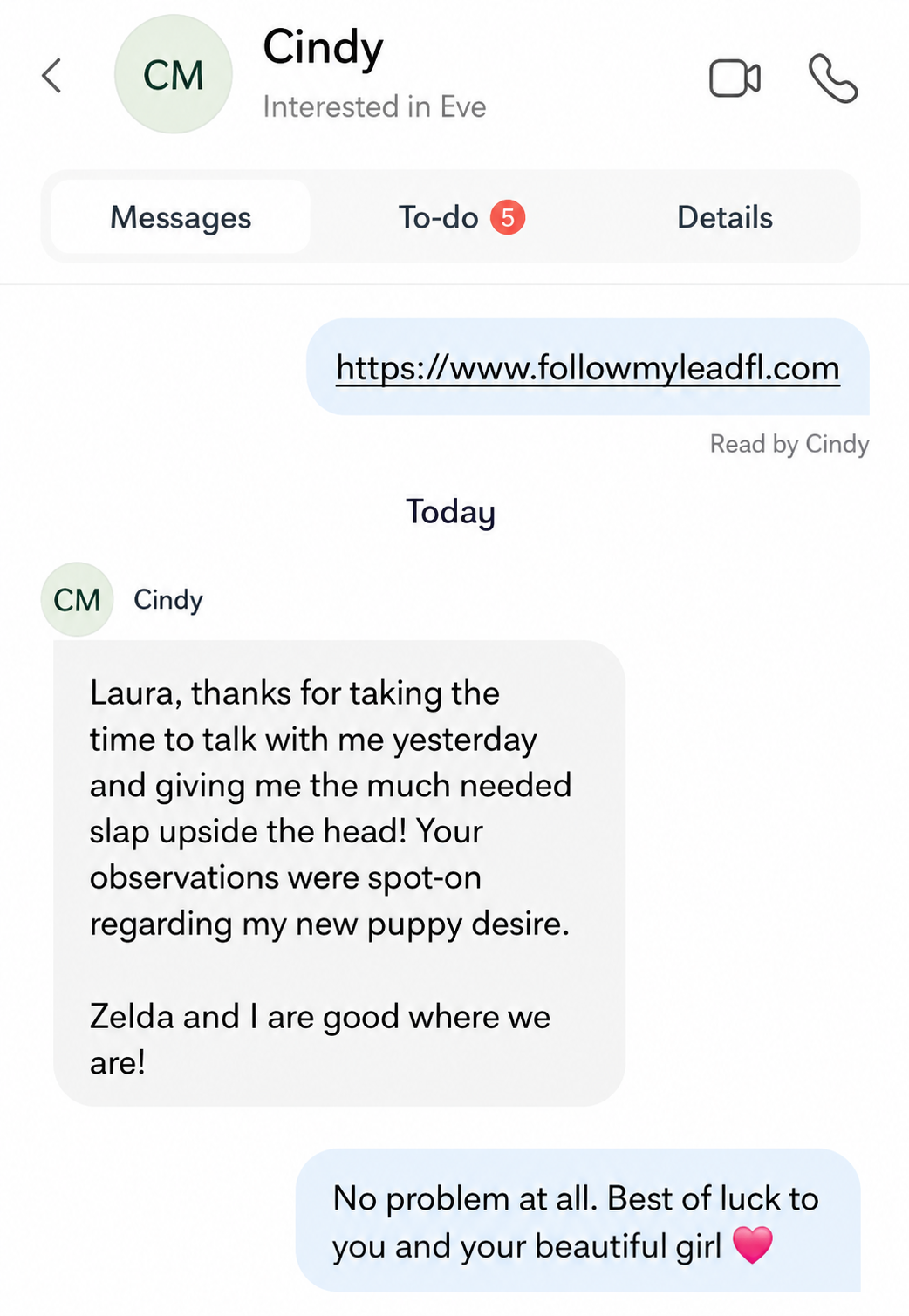
The next day, Cindy sent me a message thanking me for our conversation. After taking the time to really think about everything we discussed, she realized she and Zelda were exactly where they needed to be.
That message meant more to me than a deposit ever could.
The Maserati-Minivan Problem
One of the things I see over and over again as a professional dog trainer is families contacting me six months or a year after bringing home a puppy, hoping I can fix problems that really started with a mismatch from day one.
Usually they aren't bad owners. Usually they don't have bad dogs. They're simply trying to make a Maserati fit into a life that really needed a minivan. It's a beautiful car. It is also, spiritually, not built for a Costco run with three kids and a soccer bag.
Can you adapt? Absolutely. Many people do. But wouldn't it have been better if someone had asked the hard questions before you signed the paperwork?
Training can teach skills. Training can improve communication. Training can solve a lot of behavior problems. What training can't do is change who the dog fundamentally is.
My job isn't to decide whether someone is "good enough" to own a Great Dane. My job is to help determine whether a particular puppy is the right match for that person's lifestyle, expectations, support system, and long-term goals.
Sometimes that means one of my puppies is the perfect fit. Sometimes it means another breeder has the right dog. Sometimes it means waiting another year. And sometimes it means realizing the dog you already have is exactly enough.
At the end of the day, I'm not trying to fill my puppy list. I'm trying to make matches that last.
If you're considering adding a Great Dane puppy to your family — or trying to figure out if now is even the right time — I'd rather have the long conversation up front than the hard one six months from now. Check out Our Adoption Process to see how it works, or reach out and let's talk it through.
Related reading: Finding Your Perfect Dane, Male vs. Female: What Actually Matters and What Doesn't