
The Most Controversial 2-Letter Word in Dog Training
(Part 1 of 4: The Word Itself)
Every few months, the dog training world finds something to get its panties in a knot over. Sometimes it's e-collars. Sometimes it's prong collars. Sometimes it's force-free versus balanced. Sometimes it's:
"Did you see that trainer hit that dog?"
"No, actually they just gave the dog a firm poke."
"No, actually they were jabbing the dog in the internal organs."
You know... the usual.
This time, it's a two-letter word.
No.
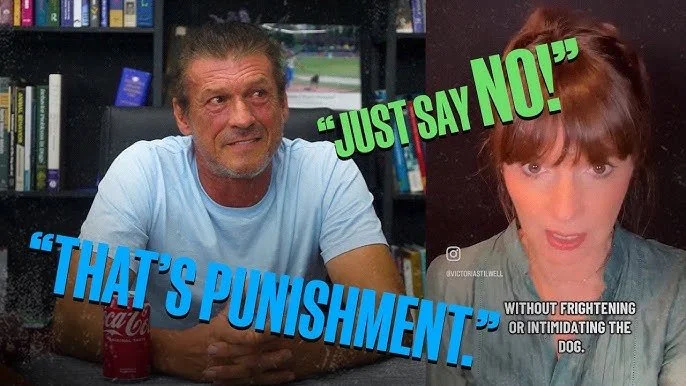
You'd think one of the first words most toddlers learn wouldn't be so controversial, but here we are. Some trainers believe "no" is a fair, necessary boundary every dog should understand. Others believe it has no place in modern dog training. Then there are trainers in the middle, who aren't really arguing about the word itself so much as what that word actually means to the dog. This particular round got kicked off by an exchange between Victoria Stilwell and Ivan Balabanov — two respected trainers, on opposite sides of this exact question, neither one entirely wrong.
Where I started
Growing up, our family dog was a black Lab named Spirit — a serial counter-surfer who never met a thing he wouldn't eat, plastic fruit and roughly 180 Crayola crayons included. He once dragged me through the woods like a sled, an eight-year-old kid chasing a cottontail rabbit against her will. Oh, he did it all. Eventually my parents brought in a trainer to deal with him, and she worked from the old-school camp — choke chain, firm boundaries, don't let him get away with anything. My relationship with that dog, and watching my parents struggle even after the training was supposedly done, is a big part of why I feel the way I do today about training that's too harsh or too inconsistent. That dog shaped more of my philosophy than any book I'd read for another fifteen years.
Then in 2007 I went to school for veterinary technology, and that's where "force-free" first became a real concept to me instead of just an internet argument. We were taught not to scruff cats, among other things — better ways to handle and restrain animals for exams that didn't rely on just muscling them into position. I'd later learn the name for a lot of that: Fear Free, the certification built on Dr. Sophia Yin's Low Stress Handling principles. It completely reframed how I thought about restraint, and it's a big part of what got me curious about the force-free camp in the first place — a genuinely different philosophy than the one I'd grown up around with Spirit.
In 2013, I took a dog training job at Petco. Their apprentice program was force-free straight through, built on Patricia McConnell and Karen Pryor's influence — choke collars, prong collars, shock collars, all of it treated as simply bad, full stop, no further discussion needed. And honestly, I had reason to believe it: I had Spirit's history behind me, plus a steady stream of dogs coming into my classes that had already been through other trainers' "quick fixes" and come out worse for it. I preached exactly what Petco and my college training had taught me. There was a genuine irony to it, too, that I noticed even then: Petco sold every one of those tools right there on the shelves, while the training curriculum banned them from the classroom entirely. I turned that irony into a sales pitch, and a good one — see someone walking down the aisle with a prong collar or a shock collar in hand, and I could usually talk them into a front-clip harness or a gentle leader instead, framed around the dog's wellbeing, and it worked more often than not.
Teaching those classes is where I got my first real taste of working with genuinely challenging dogs, and I couldn't get enough of it. The harder the case, the more excited I was to go find the answer. But like I said, there were real limitations I felt even then. Some dogs just didn't respond to a front-clip harness, a gentle leader, a no-pull backpack, or the "doggie crack" I'd patented (sarcasm fully intended) — a mix of different textured treats soaked overnight in the natural oil from duck jerky. Good enough to work miracles on plenty of dogs. Not good enough for all of them.
I didn't start out as a balanced trainer. I started out as a force-free trainer because that's what I was taught. Like most new trainers, I trusted the people teaching me. Looking back, I sometimes wonder if I was brainwashed, whitewashed, gaslit, Tide Podded... or maybe a little bit of all four. The early 2000s were kind of a blur.
It never occurred to me that many of the strongest opinions I was hearing about balanced training and aversive tools came from people who had little or no firsthand experience using them. They were copying and pasting what they'd been told because it sounded good, just like I was. To be fair, I don't think that's unique to force-free training. It happens everywhere. Someone says something confidently, enough people repeat it, and eventually it stops being questioned...
Kind of like that old advice about bonding with your dog by pinning the dog on their back and spitting in their mouth. Don't ask. Anyway, moving on.
When your toolbox is small, you have two choices: accept being stuck, or become more creative. If you're as passionate about training as I am, "stuck" isn't really an option. You observe more carefully. You think more critically. You replay sessions in your head until you can see what you missed. You question your timing, your mechanics, your understanding of the dog, and eventually yourself. There's a lot of growth that comes from solving problems with limited resources. It haunts you until you find an answer.
That's exactly what happened to me.
The questions I couldn't answer with the knowledge I had eventually pushed me to listen to trainers who had previously been off my radar because I'd been told they had nothing worthwhile to offer. I didn't agree with everything they said. Sometimes something they demonstrated made me flinch. Sometimes my first instinct was to dismiss it altogether. But instead of clicking away, I kept listening. I wanted to understand why they believed what they believed before deciding whether I agreed with it.
What I found wasn't what I'd been expecting.
I found freedom of choice instead of rigid rules. I found tools that, when used thoughtfully and skillfully, could teach in minutes what might otherwise take hours of careful shaping and nuance. Most surprising of all, I discovered that many of the things I'd been taught about balanced trainers and aversive tools simply weren't factual—or at the very least, weren't the whole story.
I wish I'd known then what I know now. There are certain cases from those early years that still haunt me — dogs I think I could have helped better if I hadn't been working with a limited toolbox. But personal experience is just that: experience. It's not always good and it's not always bad. What matters is what you actually take from it, and whether you let it make you better.
What everyone actually agrees on (yes, really)
Before anyone camps up and starts throwing rocks, it's worth pointing out how much common ground actually exists here, because you'd never guess it from the comment section:
Consistency isn't optional. A "no" that means something Tuesday and nothing Wednesday isn't a boundary, it's noise your dog eventually learns to filter out.
You can wear a word out. Say "no" for every single infraction, real or imagined, and it becomes the training equivalent of a car alarm that keeps going off for no reason — everyone learns to tune it out.
"No" shouldn't come from anger or frustration. Training shouldn't happen when you're angry in the first place — you're not showing the dog any emotional regulation in that moment, so there's no reason to expect the dog to mirror something you're not demonstrating.
Dogs need boundaries. Full stop.** We're two totally different species trying to coexist, with totally different needs. Unless, of course, you'd like to live in a den marked by urine, a soft spot to lie in built from shredded couch bedding, and maybe some added whimsy in the corner from a neighbor's cat that didn't quite make it... too far? Boundaries aren't a training philosophy. They're just necessary if you want to coexist peacefully.
How you say it matters. A flattened squeak of a "no" lands differently than a sharp one, and both land differently than an angry one. Tone is doing half the work whether you meant it to or not.
So if everybody agrees on all of that... what exactly are we fighting about?
Where they actually disagree
Turns out, not much, and also everything. The fight isn't over whether "no" works. It's over *why* it works — and that's the whole enchilada.
People actually think dogs are fluent in English. Seriously — come sit in on some of my consultations sometime. On the flip side, some people do realize dogs don't speak English, they just forget it the second they're frustrated, repeating themselves for the millionth time and shouting increasingly creative obscenities at a dog who was never going to understand the vocabulary in the first place. But in reality, it doesn't matter how frustrated you are — the dog probably just didn't understand what you meant. The answer is simple. It's conditioning, not vocabulary.
This is where Victoria's post actually runs into trouble. She talks about "no" as if it carries some kind of universal meaning to a dog, without ever explaining the mechanism behind why it works — and that's not an accident, it's a bind she's stuck in. If she actually explained the *why*, the way Ivan pushed her to, she'd have to admit "no" only means anything because it's been paired with a consequence the dog is sensitive to. And once you admit that, you've admitted "no" is functioning as a punisher — which is a hard thing to square with a training philosophy built around not using punishment at all. Easier to just let the word float there, doing its job, and never look too closely at how it's actually doing it.
If "no" carried some built-in meaning, every dog on the planet would respond to it identically no matter who said it or how that dog was raised. They don't. A dog raised with zero corrective markers doesn't flinch at "no" — the dog doesn't know it's supposed to yet. Until a word gets paired with a strong emotional response, it's the dog-training equivalent of the teacher in a Charlie Brown Peanuts cartoon — wah, wah, wah, wah — noise with no context, because nobody ever bothered to attach it to anything. What actually happens is the word gets charged, repeatedly, with something the dog already cares about — the same way a clicker's snap only means "you won!" because it's been paired with a reward often enough to earn that association. You can actually see the emotion in your dog's entire body when they hear that sound, even with no actual reward in sight. Pavlov's dogs, basically. Not because the sound itself is some special tone dogs just universally understand.
And this is usually where people start wondering if their dog is just being stubborn — ignoring the word on purpose, testing limits, being difficult. Most of the time, that's not it. Dogs are wired to notice change in their environment, not to generalize a lesson across different environments and distracting scenarios. "Sit" while a dog waits for their dinner to hit the bowl in a quiet kitchen is not the same lesson as "sit" on a busy sidewalk with a squirrel playing tag-you're-it across the street — same word, completely different job for the dog's brain. So a dog that seemed to fully get it yesterday can look like they're blowing you off today, for reasons that have nothing to do with being stubborn. That's really the whole point: context has to be taught, one example at a time, including the ones you never saw coming.
"No, you can't hump the mailman." "No, Grandma ringing the doorbell is not a sign of the Doomsday apocalypse." "No, it's not appropriate to do that around company — wait until we go to sleep." Every one of those is its own lesson to a dog, not a natural extension of some other "no" you already covered.
"No" gets loaded the same way — paired, over and over, with a slightly startling raise in the voice, a treat that never materializes, uncomfortable leash pressure, or the release of that pressure when the dog backs off. All of it doing its part in loading the response to the marker word "no." Through that repetition, "no" becomes what learning theory calls a conditioned stimulus and response — a sound carrying real weight, built entirely out of a dog's unique experience of the patterns you have or haven't created. The more black and white you are — the more consistently the word predicts the exact same thing, every time, no exceptions — the more weight it carries in changing your dog's mind and getting them to pick better choices. Same mechanism that makes a leash clip or the crinkle of a treat bag mean something. A leash clip always means we're going for a w-a-l-k. That crinkle sound means something good is about to come out of that bag and go straight into the nearest pie hole. (Built for multi-dog homes.) Neither of those objects has inherent meaning either. The dog loaded the association, one repetition at a time.
The point worth actually settling, instead of just describing: punishment is defined by what it does to behavior, not by how it looks to whoever's filming. If a stimulus makes a behavior less likely to happen again, that's a punisher. Doesn't matter if it was loud or quiet, whether the dog flinched dramatically or didn't react at all — that's a conversation about intensity and welfare, a completely different conversation from which quadrant is actually in play. So when "no" is marketed as working identically across every training philosophy — meaning it reliably makes an unwanted behavior less likely — congratulations, it's functioning as a punisher. Refusing to call it that doesn't change what it's doing. It just changes what you're willing to admit.
Some trainers lean on negative punishment instead — withholding a reward or access until the dog gets it right. Fine, but here's the question nobody in that camp seems eager to answer: how exactly does withholding a reward teach a dog that doesn't especially value what you're withholding in that particular moment? A steak means very little to a dog whose entire nervous system just locked onto a squirrel three yards away. "Don't run through that door, I've got something better for you" works beautifully on a food-motivated dog in a quiet room. It's white noise to a dog who's genetically programmed to chase movement.
Dogs are not carbon copies of each other. Even within the same breed, or the same litter, what motivates and drives one dog can be completely different from the other. Building an off-switch for one dog might hit the brakes cleanly. For another, the exact same approach just steps on the gas. You have to learn to pivot based on the dog in front of you, not the dog you were expecting — because of a previous dog you had, or because of the dog you wish you had. The dog in front of you is the dog in front of you, and no two dogs will ever be exactly alike. If I had a quarter — no, a penny — no, they don't even make pennies anymore — a nickel, then, for every time I've heard "well, I've had German Shepherds my whole life, and you'll see, there's just something wrong with this one," I could retire early. A method with exactly one tool for building an off-switch is going to work great on some dogs and do absolutely nothing for others — which means "gentler" isn't actually gentler across the board. It's just unevenly effective, and the dogs it fails are usually the ones in situations that could least afford it.
Spirit wasn't the only dog who shaped the trainer I became, but he was the first
My brother and I used to think we were the funniest kids on Earth. We'd be sitting in the back seat, and somewhere along the way we discovered that Spirit would get excited no matter what the last word was, as long as you said it in the right tone.
"Spirit... do you wannnt sommmme..."
His ears would pop up. His whole body would tense with excitement. His tail would start wagging so hard I thought it was going to fly clean off his little butt and helicopter into the sky.
"...SOAAAP?!"
My brother and I would absolutely lose it. We'd laugh until our stomachs hurt, and then one of us would do it again.
"Spirit... do you wannnt sommmme..."
His whole body would light up all over again.
"...BROCCOLI?!"
More frantic tail wagging. More hysterical laughter.
Looking back, we thought we were fooling Spirit. In reality, we were the ones being fooled. Spirit didn't care whether the last word was soap, broccoli, taxes, or just about anything else we could dream up. He wasn't responding to the noun. He was responding to us — our tone, our excitement, our body language. Everything that actually meant something to a dog.
Funny enough, that ridiculous game my brother and I played as kids ended up teaching me one of the most important lessons of my career. Dogs don't speak English. They never did. Spirit spent his whole life trying to understand us while we spent years assuming he should understand words that had no meaning to him at all. Somewhere between the Thanksgiving turkey, the plastic fruit, the peanut butter and jelly sandwich that vanished without leaving a crumb, and asking him if he wanted some... soap... he quietly taught me something I've never forgotten.
Before we ask whether a dog understands us, maybe we should first ask whether we've learned to speak in a way the dog can understand.
Where this leaves "no"
"No" was never really the controversy. It's a stand-in for a much bigger argument about whether adding an undesirable consequence, or taking away something the dog wants, have any place in the toolbox at all. Once you see it that way, the useful question stops being "should you ever say no to a dog" and becomes "what did this word actually get paired with, how clearly, and how consistently — so that it means something fair to the specific dog standing in front of you."
---
**Up next, in Part 2:** we get into the actual mechanics — the four quadrants that explain every training method that's ever existed, who's really using which ones, and the surprisingly tangled history behind force-free, balanced, and old-school training. Wolves get blamed for a lot of things they never did. A dog's daily meal becomes a training tool with two completely different names depending on which camp you ask. And somewhere in there, Cesar Millan gets bit on camera in front of a live studio audience.