
Why Dogs Jump — And How to Actually Fix It
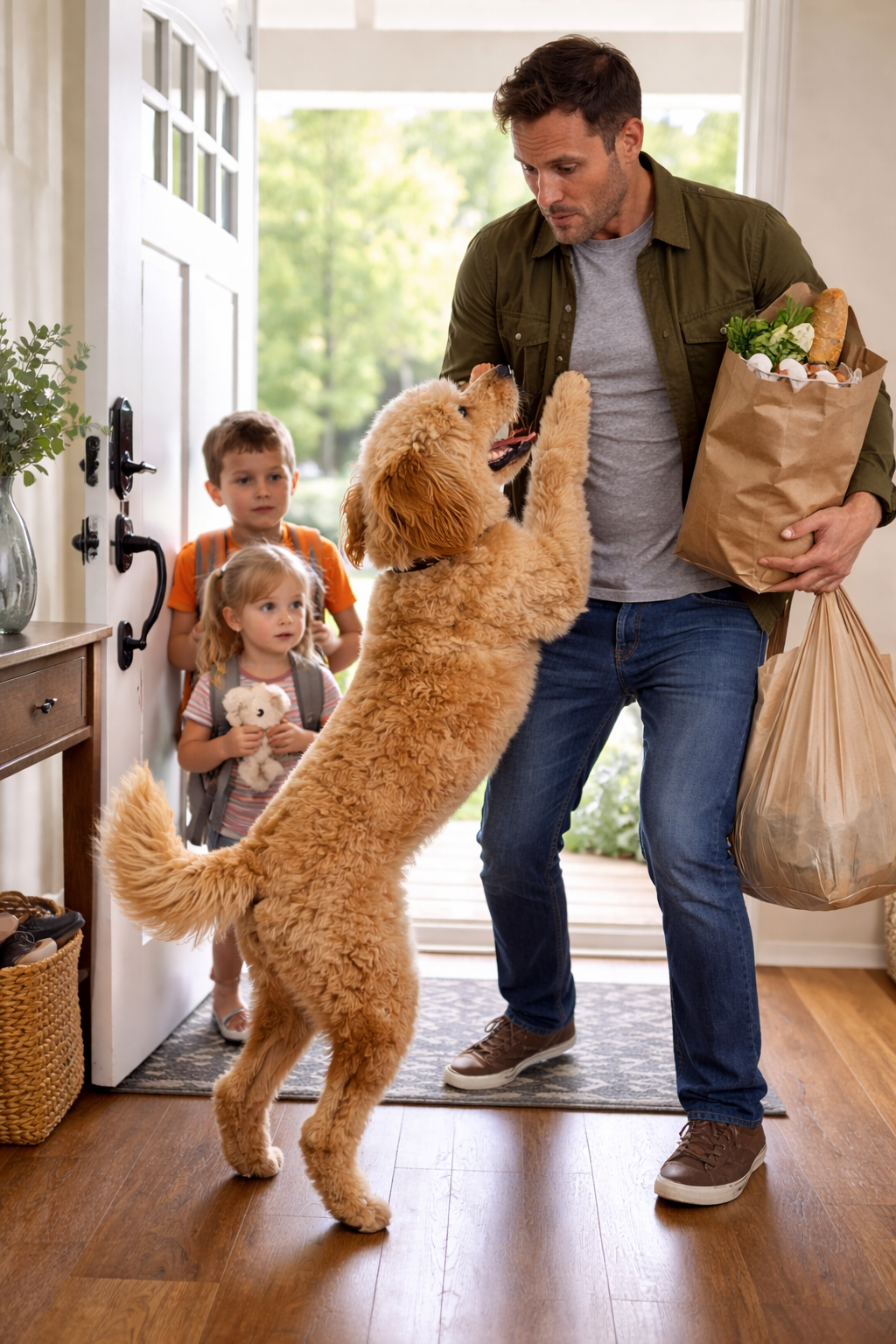
Most people don’t intentionally teach their dog to jump on guests. It usually develops over time.
The door opens, the dog’s nervous system spikes, and everything speeds up. Heart rate rises. Anticipation builds. Movement gets bigger. Jumping is simply an efficient way to close distance and immediately change what’s happening.
Sometimes it’s excitement. Sometimes it’s nervous energy. Sometimes it’s both. But at some point, the behavior made the dog feel better.
Jumping can release pent-up energy. It can create contact. It can allow the dog to control proximity. It can shift the environment in their favor. And if it results in attention or interaction, it reinforces itself.
Dogs repeat behaviors that reduce tension or increase access.
—
Step One: Manage the Environment
If you know your dog jumps when someone walks through the door, you cannot keep putting them in that situation without structure and expect a different result.
Management is not avoidance. It is prevention.
Effective management can look like:
Using a leash before the door opens so you maintain physical control
Installing gates to limit access to entryways
Crating during high-arousal arrivals
Tethering the dog to a sturdy wall anchor or heavy piece of furniture to prevent rehearsal
Sending the dog to a clearly defined “place” before guests enter
Every time a dog rehearses jumping, the neural pathway strengthens. Every time you prevent rehearsal, you protect the training you’re building.
But management alone does not rewrite learning.
---
Step Two: Teach the Rule Clearly
Before any consequence should ever be applied, the expectation must be clear.
Four feet on the floor.
Sit to greet.
Calm behavior earns access.
These behaviors must be practiced in low-distraction environments first. The dog should understand exactly what earns interaction.
If the dog is still confused, correction is unfair.
Clarity comes first.
---
Step Three: Meaningful Consequences
Once the dog clearly understands the expectation and still chooses to jump, the issue is no longer confusion. It is reinforcement history.
This is where many owners hesitate.
They repeat “off” without follow-through.
They try to outtalk the behavior.
They hope it fades.
Pussyfooting around consequences does not make training kinder. It makes it unclear.
When a rule has been clearly taught, the consequence must be meaningful enough to change the decision. It does not need to be emotional or excessive. It needs to be:
Immediate
Proportionate to the individual dog
Consistent
Jumping can no longer relieve tension or create access.
Calm behavior still can.
When the contingency becomes predictable, behavior shifts quickly. The dog pauses. The dog evaluates. The dog adjusts.
And then something important happens.
They relax.
Dogs settle when the environment is predictable.
Clear rules, outcomes, and ultimately leadership.
That is not harsh; that is structure.
---
Ready to Fix It Properly?
If your dog is jumping on guests and you’re tired of managing chaos at the door, let’s address it correctly — with structure, clarity, and a plan.
Fill out the form and I will personally review your dog’s age, history, and current challenges so we can determine the right next step.
Brooksville, FL
📲 203-815-0035