
Double Merle & Harlequin Great Danes
Genetics, Health Risks, Ethical Breeding, and Proper Testing
When discussing coat color in the Great Dane, especially merle and harlequin, it’s essential to move beyond appearance and into genetics, health, and long-term structural integrity.
Merle is visually striking. Harlequin is iconic in the breed.
But both are rooted in a genetic system that requires careful understanding and responsible management.
This guide explains:
How merle and harlequin are genetically connected
What “double merle” means
Health risks associated with improper pairings
Why a standard vet exam is not enough
Proper specialist testing protocols
Quality of life and life expectancy
How experienced breeders ethically manage merle pairings
Merle Is Required to Produce Harlequin in Great Danes
Harlequin cannot exist without merle.
Genetically:
The merle gene (M) creates a diluted, mottled coat pattern.
The harlequin modifier (H) acts on a merle base and removes the gray dilution, leaving black patches on a white background.
A harlequin Great Dane is genetically:
Merle (Mm) + Harlequin modifier (H)
Without merle, harlequin cannot be expressed.
Because of this relationship, anyone working with harlequins must fully understand merle genetics.
What Is a Double Merle Great Dane?
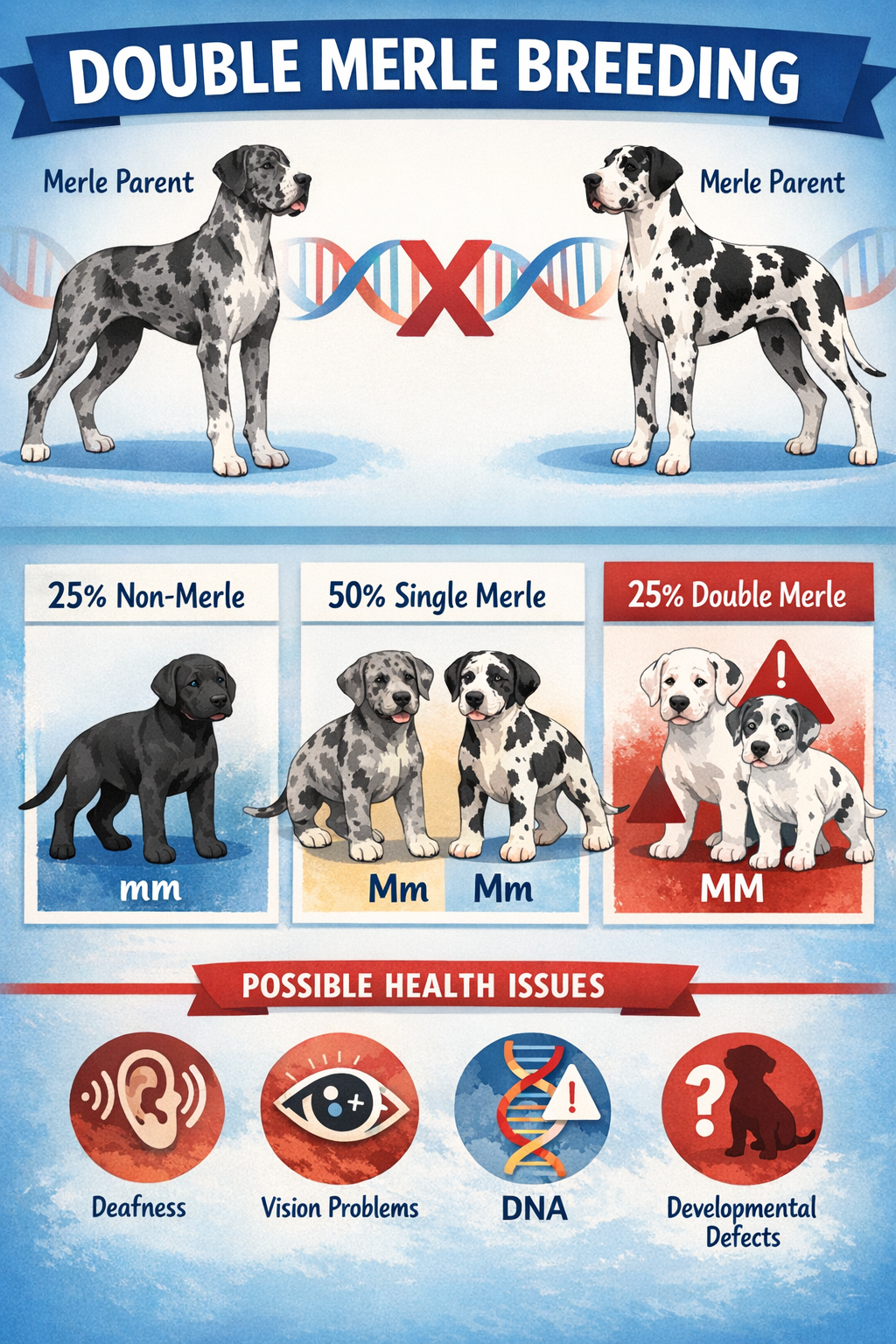
When two merle-patterned dogs are bred together, statistically:
25% MM (double merle)
50% Mm (single merle)
25% mm (non-merle)
A double merle inherits two copies of the merle gene.
Double merle does not automatically mean severe disability.
However, it significantly increases the risk of congenital hearing and vision defects due to pigment deletion during development.
Coat Color Does Not Equal Genotype
A common misconception is that only “white” Great Danes are double merle.
In reality, a double merle may appear:
Mostly white
Harlequin-patterned
Patchy with visible pigment
Or patterned in ways that do not immediately look merle
Additionally, some dogs may carry merle genetics without visibly appearing merle (cryptic merle).
Genotype determines risk — not coat label.
Health Risks of Double Merle Great Danes
The merle gene affects melanocyte development. These pigment cells are essential not only for coat color but for:
Inner ear development
Retinal structure
Pigmented skin integrity
When pigment cells fail to migrate properly during embryonic development, congenital sensory defects can result.
Hearing Loss in Double Merles
Possible outcomes:
Unilateral deafness (one ear)
Bilateral deafness (both ears)
Hearing loss occurs in utero due to degeneration of cochlear structures when pigment cells are absent.
A puppy may respond to vibration or environmental movement and still have partial hearing loss
Vision Defects in Double Merles
Increased risk of:
Microphthalmia
Colobomas
Retinal dysplasia
Reduced visual acuity
Blindness in severe cases
Some structural abnormalities are subtle and require specialist examination to diagnose.
Why a Standard Vet Exam Is Not Enough
A routine veterinary health certificate confirms:
Cardiac and respiratory health
Surface eye clarity
Behavioral responsiveness
It does not diagnose congenital deafness or subtle structural eye abnormalities.
Proper evaluation requires specialists.
Proper Testing Protocol for Double Merle Great Danes
BAER Testing (Hearing)
BAER (Brainstem Auditory Evoked Response) testing:
Objectively measures electrical activity in response to sound
Confirms hearing in each ear individually
Must be performed by a veterinary neurologist, specialty hospital, or equipped referral clinic
Ideal testing age: 6–8 weeks
Clapping or noise-response tests are not reliable indicators.
Board-Certified Ophthalmology Exam (CAER)
Performed by a boarded veterinary ophthalmologist.
Includes:
Slit-lamp examination
Pupil dilation
Retinal evaluation
Subtle structural defects cannot be identified through a routine penlight exam.
Advanced Genetic Testing for Merle
Modern testing can identify:
Merle status
Cryptic merle (Hidden from Coat Color)
Interaction with the harlequin modifier
Genetic testing defines genotype and risk category, but it does not replace physical sensory testing.
Ethical Merle × Merle Breeding: Advanced Genetic Management
Merle genetics are more complex than a simple dominant/recessive explanation.
Research has identified multiple merle allele variations related to the length of a SINE insertion in the PMEL gene. These variations influence expression and pigment impact.
Mary Langevin, author of Merle — SINE Insertion from Mc–Mh: The Incredible Story of Merle, has extensively documented:
Merle allele variations
How to interpret advanced merle testing
Which combinations elevate pigment deletion risk
How to ethically manage merle pairings through informed genetics
With high-resolution genetic testing and proper interpretation, experienced breeders can responsibly manage certain merle pairings.
Without this level of understanding, the risk of preventable sensory impairment increases.
Ethical color breeding requires:
Education
Genetic literacy
Specialist health screening
Transparent evaluation
Experience
This is not beginner-level breeding.
Quality of Life and Life Expectancy
The double merle genotype alone does not shorten lifespan.
Average lifespan for Great Danes: approximately 7–10 years.
If Unilaterally Deaf or Bilaterally Deaf- most dogs adapt well.
Training can proceed normally and life expectancy unchanged.
Structured communication and safety management are essential.
Quality of life can remain high in experienced homes.
Life expectancy is not inherently reduced.
If Vision Is Impaired mild defects are often manageable.
Severe abnormalities may require long-term management.
The lifespan depends on overall health and secondary complications.
Dogs are adaptable - their outcome depends heavily on environment, structure, and placement.
Responsible Breeding Means Responsible Education
Merle is necessary to produce harlequin in Great Danes. However, breeding merle to merle without advanced genetic understanding increases preventable risk.
Double merle does not automatically equal suffering but specialist testing is essential.
Ethical breeding prioritizes sensory integrity over color alone.
In a giant breed, sensory stability is foundational to long-term resilience.
A Note From Follow My Lead
At Follow My Lead, breeding decisions are approached through the lens of structure, resilience, and long-term stability — not simply aesthetics.
Color matters in breed preservation.
But health, sensory integrity, temperament, and structural soundness matter more.
We believe every puppy deserves:
Objective health evaluation
Thoughtful genetic planning
Transparent education
Responsible placement
If you are researching Great Dane coat color genetics, double merle concerns, or ethical breeding practices and want to have an informed conversation, we welcome that discussion.
Education protects dogs.
And in this breed, informed decisions make all the difference.