
What “Consistency” Actually Means (Because Most People Are Doing It Wrong)
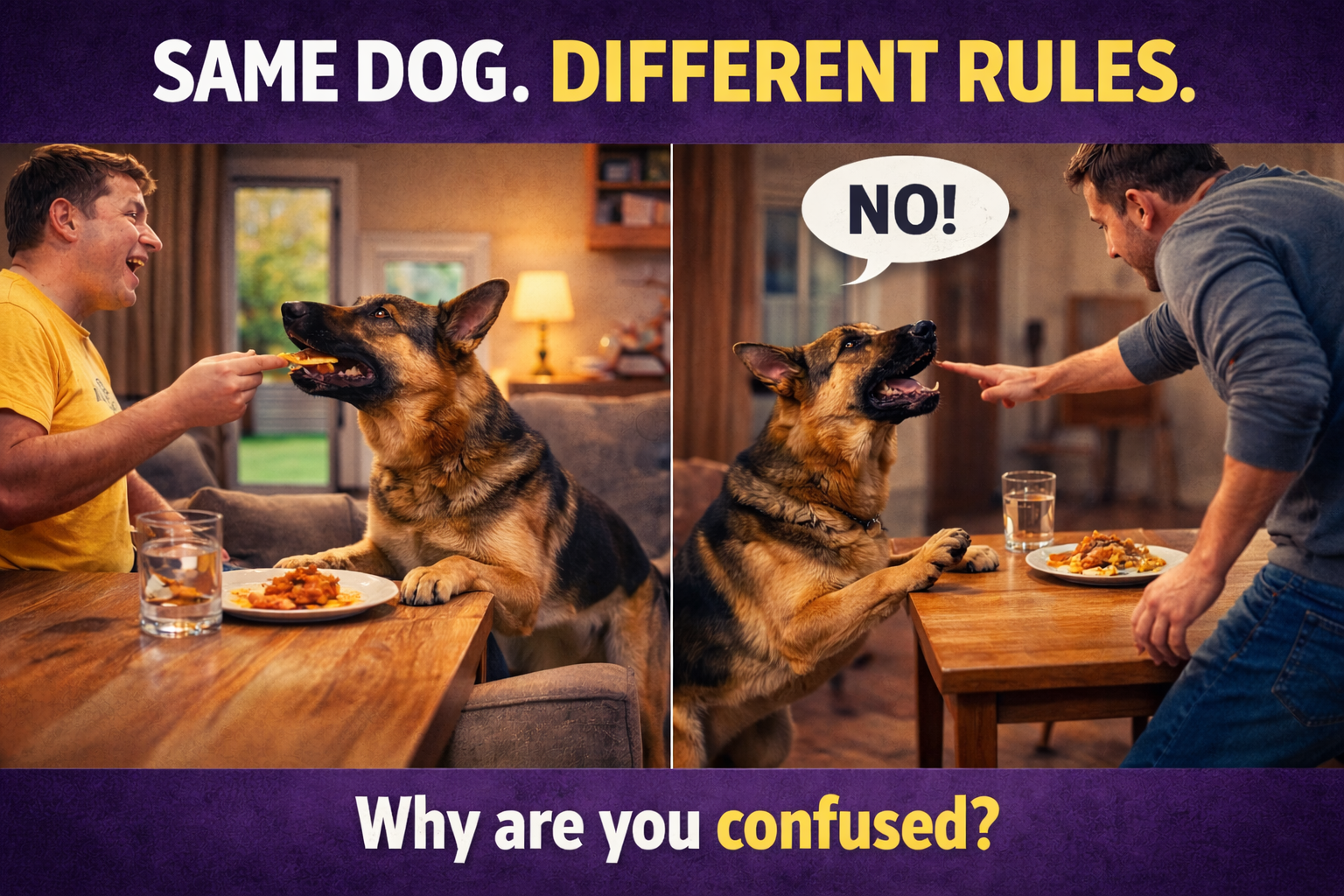
“Just be consistent.”
You hear it all the time. Trainers say it. Owners repeat it. It sounds simple.
But if you asked ten people what consistency actually means, you would get ten different answers—and most of them would not fix anything.
Because consistency is not just repeating the same command over and over again.
It is not saying “sit” five times instead of one.
And it is definitely not “trying your best most of the time.”
Consistency is clarity over time.
And this is where things start to fall apart.
Most people think they are being consistent because they are doing something regularly. Training a few times a week. Asking for behaviors here and there. Correcting sometimes. Rewarding sometimes.
But from the dog’s perspective, it looks completely different.
The problem usually is not a lack of effort—it is mixed messages.
The dog gets scolded for jumping on Grandma, but is allowed to treat the furniture like a jungle gym.
If jumping is not allowed on people, then it is not allowed—period. That means managing greetings, using a leash if needed, and reinforcing an alternative like keeping four feet on the ground or going to place. Not correcting sometimes and ignoring it other times.
The dog gets leftovers from dinner plates, but is corrected for begging at the table.
If you do not want begging, then food does not come from the table. Ever. Meals happen separately, and calm behavior is what gets rewarded—not hovering, staring, or pestering.
Dad encourages rough play on the floor, using his hands to provoke biting, but the dog gets in trouble for mouthing the kids or becoming overstimulated during grooming.
If hands are sometimes toys and sometimes off-limits, the dog cannot separate the two. Play needs clear rules—use toys, not hands—and arousal needs to be brought back down before it spills into other situations.
The dog reacts aggressively when guests arrive. Dad holds the collar and pets the dog to “reassure” him, but also does not want that behavior to continue.
Petting and soothing in that moment often reinforces the state of mind, not calms it.
If you disagree with the behavior, that needs to be clear. A firm “no,” appropriate leash correction, and then immediately shifting focus to reward calm, neutral behavior.
The dog is expected to walk nicely on leash, but is regularly allowed to pull when the owner is in a hurry.
If leash pressure sometimes matters and sometimes does not, the dog learns to test it. Either the expectation is loose leash walking every time, or the walk is structured differently—but it cannot change based on convenience.
The dog is told to settle or hold place, but is released whenever it becomes inconvenient to enforce.
If “place” only lasts until the dog gets restless, then the command does not mean anything. Duration is part of the behavior, and it needs to be built and followed through—not negotiated in the moment.
The dog is corrected for barking at noises, but is also encouraged to “alert” or gets attention when it does.
If barking is not allowed, then stop paying it. No talking, no engagement—just clear correction and reward the moment the dog is quiet.
The dog is expected to come when called, but the command is repeated multiple times without follow-through.
If “come” is optional the first four times, it becomes optional the fifth. Give the command once, and make sure it happens—through long lines, guidance, or setup—not repetition.
The dog is crated for structure at times, but at other times is given full freedom without the skills to handle it.
Freedom should match skill level. If the dog cannot handle the space, the answer is not more freedom—it is more structure until the behavior improves.
The dog has every toy imaginable, free access to the backyard through a doggy door, full access to the couch, the bed, and the best resting spots in the house. Food is always available. Water is always available. There is even another dog to play with.
But when the dog is called, it does not come. It does not have manners. It becomes overstimulated by every noise, barks at the windows, chews up furniture, and uses the bathroom in the house.
From the owner’s perspective, the dog has everything it could possibly want.
From the dog’s perspective, there is no reason to listen.
When everything is freely available, your direction stops meaning anything. Access to space, food, movement, and interaction should come through you—not in spite of you.
From the dog’s perspective, none of this is clear.
These are not separate problems. They are the same problem—unclear expectations.
Real consistency shows up in three places.
First—your expectations.
If a behavior matters, it needs to matter every time. Not just when it is convenient. Not just when you have the energy.
If your dog is not allowed to pull on the leash, that cannot turn into “it is fine today because I am in a hurry.”
Dogs learn patterns. If the pattern changes depending on your mood, they stop taking the rule seriously.
Second—your follow-through.
This is where most people lose it.
You ask for something. The dog does not respond. And then nothing happens.
Or you repeat yourself. Or you give up. Or you physically guide them without any real clarity behind it.
From the dog’s perspective, the lesson becomes: “I can wait this out.”
Consistency means the behavior is followed through to completion, or you adjust the situation so the dog can succeed—but you do not just let it go.
Third—your timing.
This is the subtle one, but it matters just as much.
Rewarding late. Correcting late. Missing the moment entirely.
Dogs learn from what just happened—not what you meant to respond to.
If your timing is inconsistent, your communication is inconsistent.
And then people start saying things like, “They know it… they just do not want to do it.”
In most cases, that is not what is happening.
Consistency is not about being perfect.
It is about being predictable.
Your dog should not have to guess what matters today.
They should already know.
And if you are honest about it, most training issues are not coming from a lack of knowledge.
They are coming from a lack of follow-through.
That gap—between what you ask and what you enforce—is where the behavior breaks down.
You do not need more commands.
You do not need more tools.
You do not need a completely different approach.
You need clearer patterns.
That is what consistency actually is.