
Male vs Female Great Dane: What Actually Matters (and What Doesn’t)
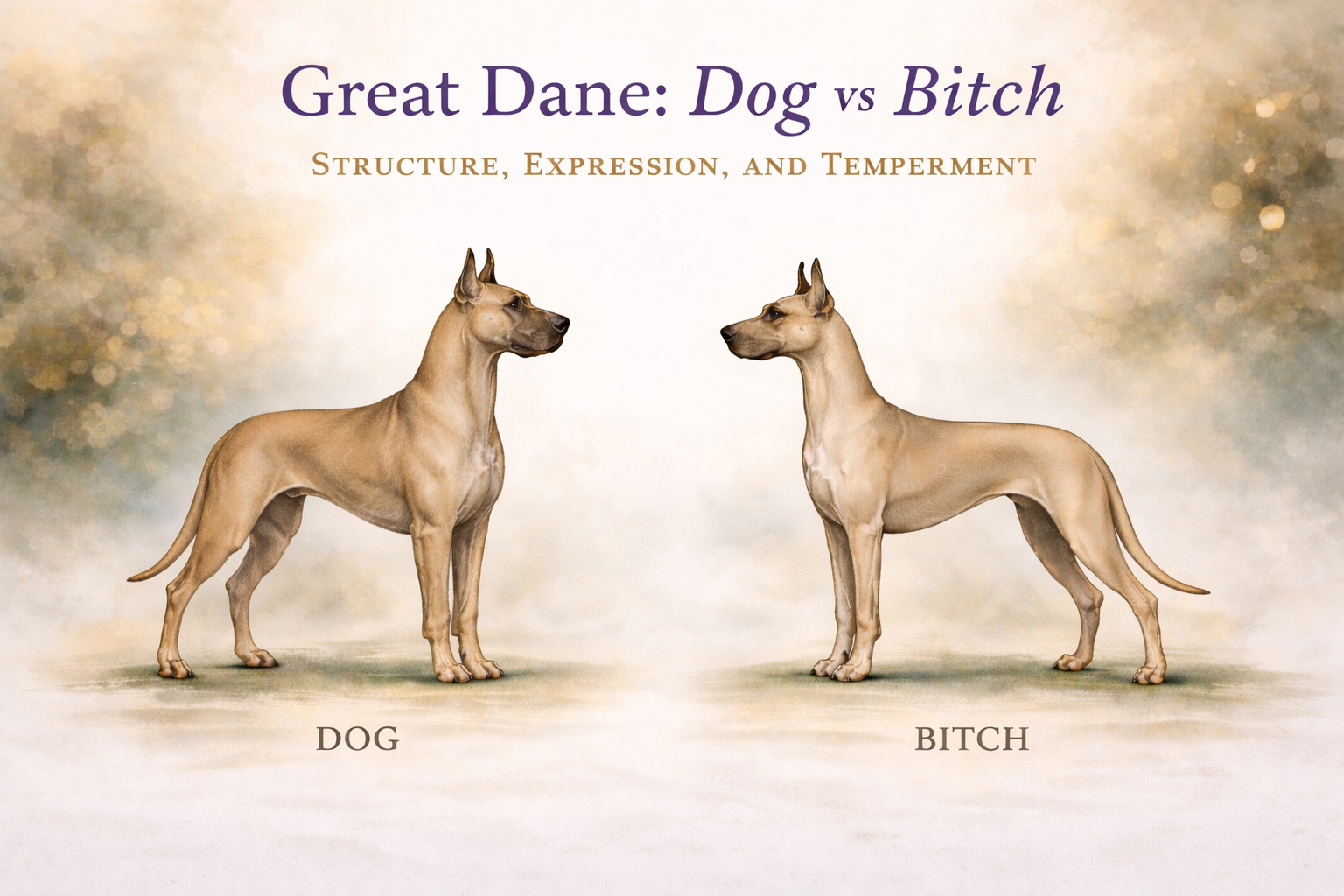
People often ask whether they should get a male or female Great Dane.
There are some general differences, and over time you do start to notice patterns. But this is also one of those decisions people tend to overemphasize, especially when they are first starting their search.
In my experience, females tend to be a bit more pushy. They usually require clearer structure and consistency, but once they understand the expectations, they are extremely loyal and very connected to their person.
Males are generally a little softer overall. They tend to be more affectionate and easygoing, but they also take longer to mature and can be more distracted or physically unaware as they grow.
These are not just personal observations. Even looking at general breed trends, females tend to mature faster and have longer attention spans during training, while males are often more playful and slower to settle into that structure.
That being said, these are patterns—not guarantees.
Why people fixate on wanting a male
A lot of people come into the process already set on wanting a male.
Sometimes there is a specific reason, like they already have a female at home and want to avoid potential conflict. That can be a consideration, but it is not a guarantee either way. Long-term compatibility depends much more on temperament than it does on sex.
Other times, it is just a preference. People have had a male before, or they have heard that males are “easier,” or they simply have it in their head that a male is what they want.
The problem is not having a preference.
The problem is making that the only deciding factor.
Adding a second dog: male vs female pairings
One of the more common reasons people prefer a specific sex is because they already have a dog at home.
The general rule people hear is that opposite-sex pairings tend to be easier, while same-sex pairings—especially female to female—can be more likely to create tension long-term.
There is some truth to that in certain situations, but it is not a guarantee.
What matters more is the individual temperament of both dogs.
A stable, well-socialized female can absolutely live peacefully with another female. Just like two males can coexist without issue if their temperaments and structure are appropriate.
Where problems tend to show up is when you have two dogs with similar traits that clash. Two pushy personalities, two dogs competing for space or control, or a lack of clear structure in the home.
That is where people run into trouble—not simply because both dogs are male or female.
When I am placing a puppy into a home that already has a dog, I am looking at how those personalities will interact, not just the sex of the dogs.
Because again, compatibility is not determined by labels. It is determined by the individuals.
Two easy dogs can live together peacefully regardless of sex. Two difficult dogs can create problems regardless of sex.
What actually matters more than gender
When I am placing a puppy, I am not looking at male vs female first. I am looking at the individual dog and the individual home.
Things like experience level, natural demeanor, leadership style, activity level, and environment are what determine whether a dog will be successful long-term.
Some puppies are more sensitive and need patience, but also need to be pushed in the right way to build confidence.
Some are more pushy and need very clear, consistent boundaries so they understand what is expected.
And then you have your middle-of-the-pack dogs, which tend to be more balanced and are often much easier for newer owners to work with.
That matters far more than whether the dog is male or female.
Understanding the breed itself
Great Danes as a breed are described by organizations like the and the as friendly, dependable, and even-tempered dogs.
At the same time, they are a giant breed that requires consistent training and clear expectations because of their size and strength.
They are also categorized differently depending on the organization. The places them in the Working Group, while the places them in the Guardian Dog Group.
That alone tells you something.
They are not just a laid-back companion, but they are also not a high-drive working dog in the traditional sense. They fall somewhere in the middle, which is why structure, stability, and environment matter so much.
These organizations describe what the breed should be at its best.
What determines whether a dog actually becomes that in your home is not whether it is male or female—it is how well that dog’s temperament, energy level, and personality match the environment it is going into.
Activity level and environment
This is one of the biggest factors people overlook.
A high-drive, high-energy dog placed into a lower-energy home is going to struggle, not because the dog is “bad,” but because its needs are not being met.
A busy household with a lot of people, noise, and movement requires a dog that can handle that environment.
A quieter home with older adults or a slower pace requires a different type of dog.
If those two things do not line up, problems start to show up later as the dog matures.
That is not a training issue. That is a mismatch.
The idea of “the puppy choosing you”
Another thing that comes up a lot is the idea that a puppy will “choose” its person.
People want to sit with the litter and have a puppy run up to them, jump on them, lick them, and form an instant connection.
And while that can feel great in the moment, it is not always the best way to determine which puppy is actually the right fit.
The boldest, most outgoing puppy in that moment is not always the best match for every home. And a puppy that is more reserved may just need time and guidance to develop.
You cannot fully evaluate a puppy’s temperament in an hour or two.
I have been watching these puppies since they were born. I have seen how they respond to new environments, new stimuli, different types of handling, and how they develop over time.
That is what I base my placements on.
A quick reality check
One of the most common things I hear—across every breed, not just Great Danes—is:
“I’ve had multiple dogs of this breed, and this one is nothing like the others.”
And that is exactly the point.
Even within the same breed, and even within the same litter, dogs can be drastically different.
People fall in love with one particular dog and assume that the entire breed will be just like that dog.
That is not how it works.
Which is why choosing based on sex alone does not tell you nearly as much as people think it does.
The bottom line
Choosing between a male and a female Great Dane is not irrelevant—but it is not the most important decision you will make.
Personality, structure, environment, and expectations matter more.
Because at the end of the day, you are not just choosing a puppy.
You are choosing what that dog is going to be like in your home for the next several years.
And getting that right starts with looking beyond the surface.
This is very solid—clear, authoritative, and still sounds like you.