
Abuse, Neglect, and Exploitation: Why the Distinction Matters
If we're going to have meaningful conversations about animal welfare, we need to be more precise with the language we use.
The word "abuse" gets thrown around so often that it has almost lost its meaning. I've seen people accuse others of abusing their dogs just for crate training. I've seen people say it's abusive to restrict a dog's freedom by using a leash indoors while teaching house rules and setting boundaries. The thought of not sleeping with their dogs or allowing them on the furniture makes some people cringe.
People think it's abusive to allow a puppy to learn emotional regulation by working through frustration instead of coming to their rescue every time they're upset. They believe tools such as prong collars and e-collars, which can provide dogs with clear communication when used correctly, are so abusive that they're trying to lobby to outlaw them.
The same thing happens in other areas of the dog world. Responsible breeders are called abusive simply because they choose to breed dogs. Dog show exhibitors are accused of abuse because their dogs have cropped ears or docked tails. Entire training philosophies are dismissed as abusive simply because someone disagrees with the methods being used.
Disagreement alone doesn't make something abuse.
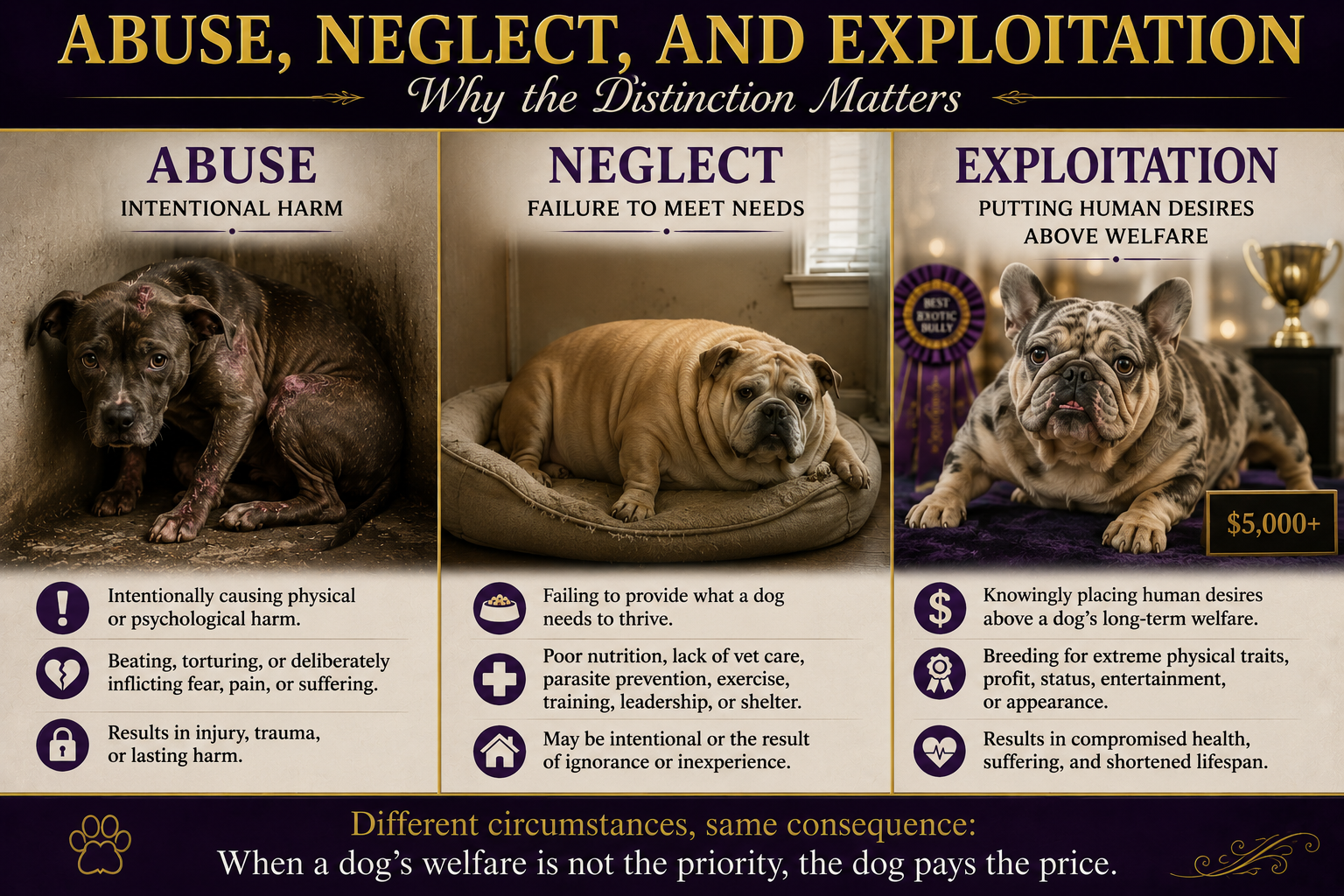
When I think of abuse, I think of intentionally causing physical or psychological harm—beating a dog, torturing it, or deliberately inflicting fear, pain, or suffering. There is no place for training or handling methods that result in lasting physical or psychological harm. Humane, meaningful consequences that help a dog learn appropriate behavior are fundamentally different from methods that intentionally inflict suffering or leave lasting damage. Whether the harm was motivated by anger, punishment, ignorance, or a misguided belief that it was necessary to teach a lesson doesn't change the outcome for the animal or its welfare.
Neglect is different. Neglect is failing to provide what a dog needs to thrive. That includes proper nutrition, veterinary care, parasite prevention, grooming, nail care, exercise, training, leadership, socialization, and appropriate shelter. Neglect isn't always intentional. Sometimes it's simply the result of inexperience, poor education, or not understanding what a dog actually needs.
Sometimes we unintentionally harm the animals we love most. We overfeed them because food is how we show affection, and we avoid all frustration because we don't want them to experience discomfort. We allow unlimited freedom without teaching boundaries, excuse undesirable behavior because we feel sorry for them, and fail to provide the training, structure, and leadership they need.
None of those decisions are usually made out of cruelty. They often come from a place of love, yet they can still contribute to obesity, anxiety, poor impulse control, and a lower quality of life.
Love is an emotion. Welfare is the outcome of consistently meeting an animal's physical, mental, and behavioral needs. The two often go hand in hand, but they are not the same thing.
A dog may be left in the backyard with very little interaction. It may never receive proper training, veterinary care, parasite prevention, or grooming. It may spend its life roaming the neighborhood because no one repaired the fence or bothered to secure it. Sometimes that's intentional. Many times it isn't. Either way, the dog's needs still aren't being met.
Dogs escape. Accidental litters happen. Responsible owners learn from those mistakes and take steps to prevent them from happening again. But when unwanted litters continue because little effort is made to prevent them, I would consider that neglect. Preventing unwanted litters is part of responsible dog ownership.
If abuse is about intentionally causing harm and neglect is about failing to meet a dog's needs, then exploitation is about knowingly placing human desires above the dog's long-term welfare. Of the three, it's probably the concept we discuss the least, yet I believe it deserves far more attention than it gets.
A dog may never miss a meal. It may sleep on the couch every night. It may be adored by its family and receive excellent veterinary care...
...and still be exploited.
To me, exploitation occurs when people knowingly place their own desires, entertainment, status, or financial gain ahead of the dog's long-term welfare.
Intentionally breeding dogs with exaggerated physical traits that compromise their ability to breathe, move, reproduce naturally, or function comfortably simply because those traits are profitable, trendy, or visually appealing is, in my opinion, exploitation.
The same idea applies to the term "backyard breeder." Not every backyard breeder falls into the same category. Some are neglectful because they repeatedly fail to prevent unwanted litters. Others genuinely love and care for their dogs, yet still make breeding decisions that prioritize convenience, profit, or appearance over health and function.
There are also breeders whose dogs are beautifully cared for. They live in the home, sleep on the couch, receive excellent veterinary care, and are genuinely loved.
A healthy, well-loved dog is not automatically a good breeding candidate. Ethical breeding requires intentionally evaluating whether that dog's genetics, structure, temperament, and overall health are worthy of preserving and passing on to the next generation.
Intentionally breeding dogs without appropriate health testing, breeding unstable temperaments, poor structure, or traits that compromise health and function places human desires above the long-term welfare of the dogs being produced. That is exploitation.
One of the reasons I appreciate the AKC Canine Good Citizen program is that before a dog is ever evaluated, the owner agrees to the Responsible Dog Owner's Pledge. It covers providing proper veterinary care, nutrition, grooming, exercise, training, identification, and being a responsible member of the community. In many ways, it's a simple framework for good husbandry. The obedience test gets most of the attention, but responsible ownership begins long before a dog ever learns to sit or stay.
I honestly wish responsible animal husbandry was taught in school. So many welfare issues aren't the result of cruelty—they're the result of people simply never being taught what responsible animal ownership actually looks like.
I think we do animals a disservice when we reduce every disagreement to the word "abuse." Sometimes the issue is abuse. Sometimes it's neglect. Sometimes it's exploitation. And sometimes it's simply a difference in husbandry, breeding, or training philosophy—not cruelty.
My hope isn't that everyone walks away agreeing with me. It's that we become more thoughtful in the conversations we have about animal welfare. Instead of immediately labeling something as abuse because it isn't how we would raise, train, or live with our own dogs, let's ask questions. Let's listen. Let's learn from different perspectives, evaluate the evidence, and then decide what we believe is best for our own dogs.
None of us know everything. Our understanding evolves as we gain knowledge and experience, but we must remain open to challenging our own assumptions, especially when they're rooted in strong emotional ties. By doing so, we'll make better decisions and provide a higher standard of welfare for the animals that depend on us.
The willingness to listen, question our assumptions, and continue learning doesn't just improve the lives of our dogs. It reminds us that meaningful conversations begin with curiosity, not condemnation. Perhaps that's a lesson that extends beyond animal welfare as well.