
How to Pick Out the Perfect Puppy
Five things I look for inFive things I look for in a puppy I’d want to bring home-
When I look at a puppy, I’m not trying to predict their entire future. I’m looking for clues about how their nervous system works right now. Those clues tell me far more than energy, confidence displays, or who steals the spotlight first.
The first thing I notice is how a puppy settles after something exciting happens. A puppy that can come down on their own, without needing to be redirected or entertained, is already showing regulation. That skill becomes priceless later, even though it doesn’t photograph well.
I look for curiosity without panic. Interest is good. Bravado isn’t required. Puppies who pause, observe, and then engage usually handle new environments better long-term than the ones who treat every situation like a personal challenge. Confidence doesn’t have to be loud to be real.
I pay close attention to how frustration is handled. A delayed reward. A mild obstacle. A moment where things don’t go their way. I’m not looking for perfection — I’m watching recovery. A puppy who can regroup instead of spiraling is usually easier to train and live with as they grow.
The fourth thing is how much effort it takes to bring them back to neutral. If a puppy needs constant input to stay regulated, that becomes exhausting fast. For the record, “exhausting” is not a personality trait. 🙂
I also watch how they interact with people. Engagement is great. Dependence is not. Puppies who can check in and then move on tend to grow into dogs that feel secure rather than anxious.
There’s also a lot of pressure to feel a “magic connection” right away. People fall in love with a color, a marking, or a single photo and assume that feeling is telling them something important. Sometimes it is. Often, it’s just chemistry mixed with aesthetics.
A photograph captures a moment — not resilience, recovery, or how a puppy handles stress when things don’t go their way. Those qualities show up over time, in patterns, not snapshots.
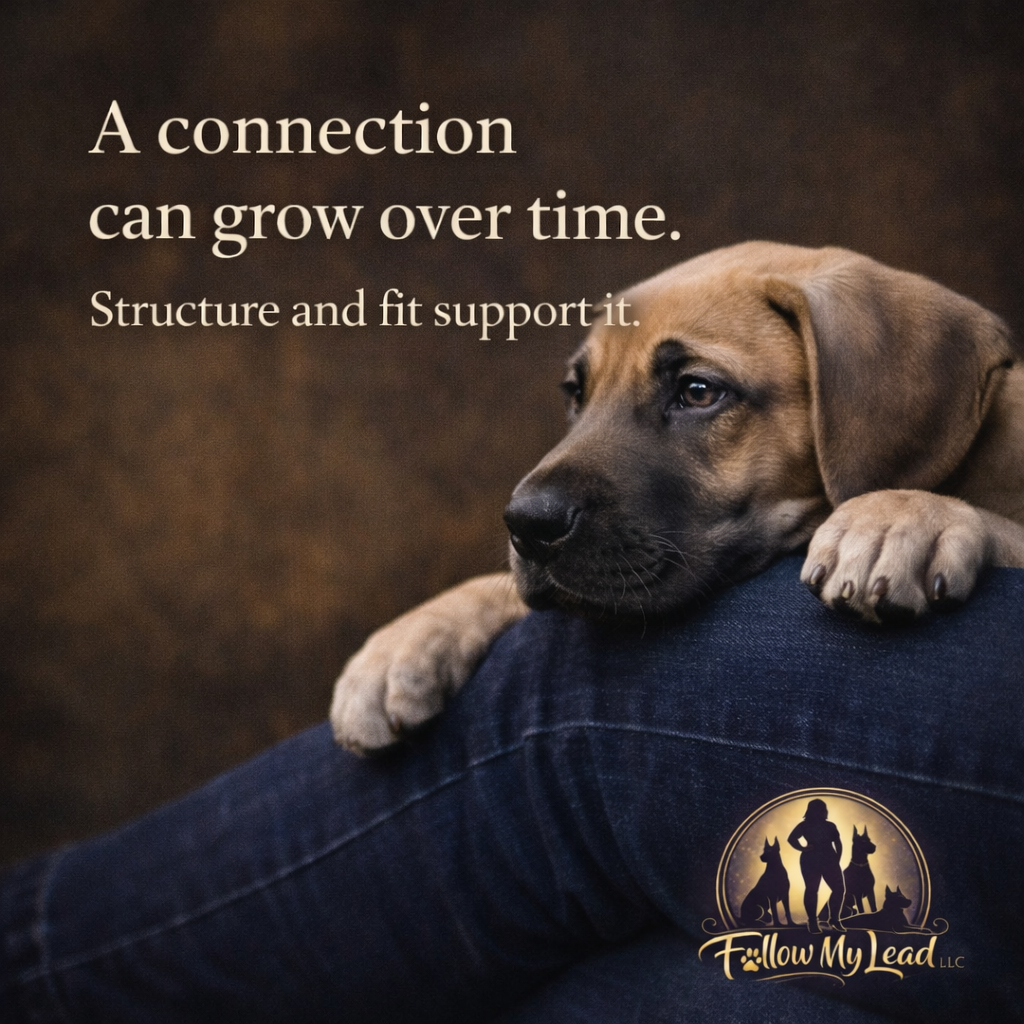
A connection can grow over time; structure and fit are what support it.
You can build confidence. You can build drive. You can build skills. What’s much harder to build later is emotional regulation — a nervous system that already knows how to settle, recover, and move through the world with stability.
That’s often the puppy who surprises you. The connection isn’t loud or instant, but it deepens steadily over time. Not flashy. Not needy. Just secure. And more often than not, those are the dogs that become your heart dogs — quietly connected and built to last.