
Shock Collar vs. E-Collar
Why the Difference Matters More Than People Think
Shock Collars, E-Collars, and Why This Topic Is So Controversial
Electronic collars are one of the most misunderstood tools in dog training.
There is a lot of emotion around this topic — and for good reason. E-collars have been misused, misunderstood, and poorly explained for years. As a result, these tools are banned in some countries and actively being challenged in others, including here in the United States.
Most of that backlash is not about responsible use.
It is about misinformation, poor equipment, and people using tools they do not fully understand.
That is where the real problem lives.
Why People Say “Shock Collar”
The term shock collar gets used constantly, but rarely accurately.
Sometimes it is used emotionally — when people are frustrated with their dog’s behavior and looking for a quick fix. That mindset is harmful, because training does not work through instant gratification or button-pushing.
Sometimes it is simply inaccurate — lumping modern e-collars together with outdated devices that earned their reputation through harsh, inconsistent stimulation.
And sometimes it is about price — people buying the cheapest option online without realizing that poor equipment plus poor timing is a recipe for confusion.
Even with good intentions, lack of understanding creates problems.
The Tool Isn’t the Issue — Misuse Is
When e-collars are used incorrectly, they can absolutely cause:
Confusion
Anxiety
Avoidance behaviors
Loss of trust
This happens when people skip foundation training, do not understand timing, or follow advice from unqualified sources. Dogs are then left trying to guess what the correction meant — and guessing is what creates instability.
That is the source of the controversy.
Not the existence of the tool itself.
Where I Stand
At Follow My Lead, I believe e-collars can be used ethically, fairly, and effectively — but only when they are used correctly.
That means:
The dog understands the behavior first
The collar is properly introduced and conditioned
Timing is precise and consistent
The equipment is reliable
The handler understands how dogs learn
Used improperly, these tools can cause harm.
Used correctly, they create clarity and accountability.
Both of those statements can be true at the same time.
Shock Collars vs. Modern E-Collars: There Is a Difference
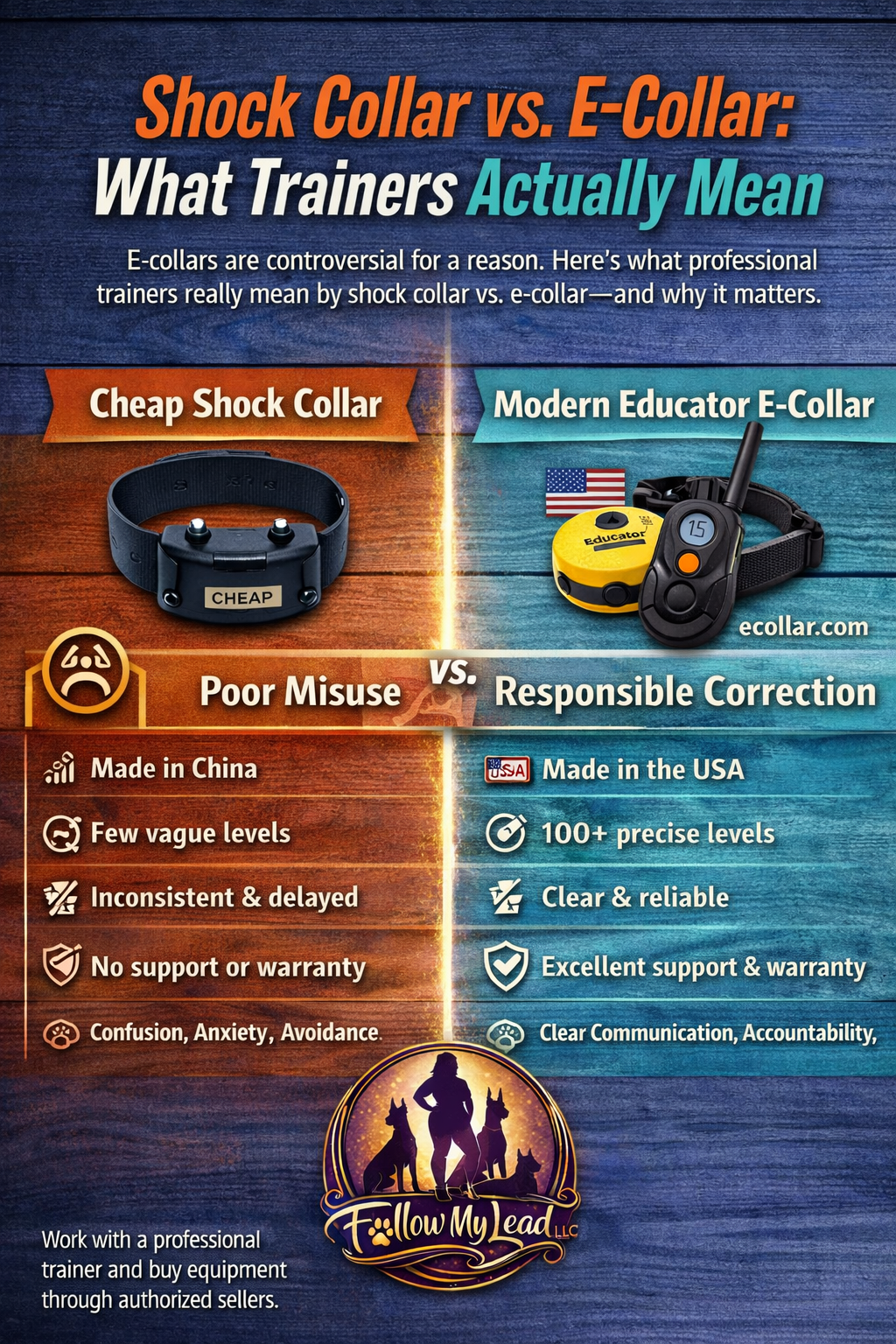
Most negative experiences people associate with e-collars come from cheap shock collars.
These are typically:
Made in China
Mass-produced under many brand names
Limited to a handful of vague intensity levels
Inconsistent in output and timing
Sold with little to no customer support or warranty
These collars rely on surprise rather than communication. Dogs feel something happen but do not clearly understand why. That is unfair — and that is what gives “shock collars” their reputation.
Modern E-Collars Are Built for Precision
Professional-grade systems like Educator are a completely different category of tool.
Educator e-collars are:
Manufactured and assembled in the USA
Built with 100+ precise stimulation levels
Designed with blunt-pulse technology, not sharp shocks
Consistent, reliable, and immediate
Backed by strong customer support and a 2-year warranty on parts
Supported directly through ecollar.com
This level of control is what allows correction to be fair and proportional instead of confusing.
Yes — We Use E-Collars as Punishment
I want to be very clear about this.
At Follow My Lead, we do use e-collars as punishment — but only after the dog fully understands the behavior.
My approach is strongly influenced by Larry Krohn, whose methodology emphasizes clarity, conditioning, and accountability.
Punishment in our program is:
Never emotional
Never random
Never applied to behaviors the dog does not understand
A dog is never corrected for ignorance.
What “Fair” Punishment Actually Looks Like
Before an e-collar is ever used as a correction:
The behavior has already been taught
The dog understands the command
The dog knows how to turn pressure off
The expectation is clear
When a correction happens, the dog understands exactly why — and how to avoid it next time. That clarity is what makes punishment fair instead of frightening.
Cheap shock collars cannot provide this level of precision, which is why they fail in responsible training systems.
Why Equipment Quality Matters
Humane and methodical e-collar training relies on timing and consistency. Cheap equipment removes that margin of safety.
Educator e-collars allow us to:
Work at low levels for conditioning
Apply higher levels only when warranted
Maintain consistency across environments
Train without guessing
When punishment is part of the equation, precision is non-negotiable.
Why Buy Through Follow My Lead
Follow My Lead is an authorized Educator dealer.
That means you are not just buying a collar — you are buying:
Genuine Educator equipment
Help choosing the correct system
Guidance on proper use
Support from a trainer who actually uses these tools
E-collars are not plug-and-play devices. They are part of a training system, and the outcome depends on how they are used.
Final Thoughts
Punishment without understanding is abuse.
Punishment with understanding is communication.
Dogs thrive when expectations are clear and consistent.
The tool does not determine whether training is ethical — the knowledge behind it does.
If you are considering an e-collar, do it the right way: with the right equipment, the right education, and professional guidance.
👉 Purchase your Educator e-collar through Follow My Lead or contact us directly to choose the correct system for your dog.